
Every second, the brain is flooded with sights, sounds, smells, and signals from inside the body.
Yet only a fraction of this information reaches our conscious awareness, thanks to neural systems that filter out what is familiar or unimportant.
This filtering happens constantly in everyday life. After a while, we may stop noticing the hum of an air conditioner, the feel of clothing against our skin, or a familiar smell in the room.
The signals are still there, but the brain pushes them into the background so we can focus on new or potentially important information.
A new study published in Neuroscience Bulletin suggests that mescaline, a chemical found in certain cacti that can cause hallucinations, may alter how the brain responds to incoming sensory information.
Mescaline has been used in spiritual and ceremonial practices for thousands of years. It produces its effects partly by activating some of the same receptors that normally respond to serotonin, a chemical messenger that helps brain cells communicate and plays a role in mood, sleep, and sensory perception.
By engaging these receptors, mescaline can change how people perceive colors, shapes, time, their surroundings, and even themselves.
The cerebellum has traditionally been associated with coordinating movement and balance. But growing evidence suggests it is also involved in attention, emotion, memory, and the processing of sensory information.

One proposed role of the cerebellum is to help the brain distinguish familiar or expected sensations from signals that may require attention. The new study examined whether mescaline affected activity in this region and its communication with other parts of the brain.
In the first experiment, the researchers used 24 adult rats – 12 females and 12 males. Half received mescaline, while the other half received a control solution.
The animals' brain activity was then tracked while they were awake using functional magnetic resonance imaging (fMRI).
The rats had been gradually made accustomed to the scanner beforehand, allowing the scans to be conducted without anesthesia, which could have affected brain activity.
The scans revealed an unusual pattern. Mescaline reduced activity within parts of the cerebellum, while strengthening communication between the cerebellum and other brain regions.
The strongest increases involved connections between the cerebellum's deep nuclei and the hippocampus, thalamus, somatosensory cortex, and midbrain, study first author and pharmaceutical scientist Noah Cavallaro of Northeastern University in the US told ScienceAlert.
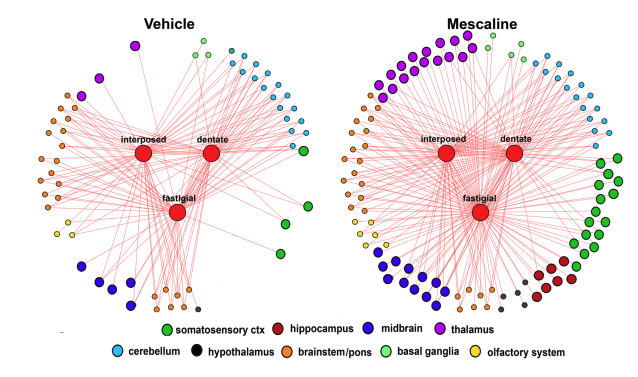
The hippocampal connection was particularly striking: Under normal conditions, it had essentially no functional connection to the cerebellar nuclei, but after mescaline it connected to seven of nine hippocampal subregions.
"If that filtering breaks down while connectivity to memory (hippocampus), sensory relay (thalamus), and body-sense (somatosensory cortex) regions goes up, you get a plausible mechanism for altered bodily awareness and perception: raw, unfiltered sensory and interoceptive information reaching regions that would normally only receive a processed, filtered signal," Cavallaro said.
First, the rats were exposed to the scent of almond, which is normally rewarding to them. The smell produced a clear brain response in the control rats, but almost no response in those given mescaline.
In a separate experiment involving 16 rats, the team tested a process known as prepulse inhibition.
To test this response, the researchers exposed the rats given mescaline to a series of tones at low, middle, and high frequencies. According to the study, the animals filtered the repeated loud sounds effectively at the low and high frequencies, but not at the middle frequency.
"This selectivity argues against a model where mescaline just 'turns off' the cerebellum's filtering function," Cavallaro said.
"It looks more like the drug is recalibrating the gain or precision assigned to different sensory channels, suppressing some and amplifying others, rather than degrading the whole system uniformly."
The researchers do not yet have a mechanistic explanation for why the middle frequency behaved differently from the low and high frequencies. Cavallaro said this remains an open question for follow-up research.

Earlier this year, an analysis of brain scans from 267 people found that five psychedelics, including mescaline, shared some effects on communication between large-scale brain networks.
As ScienceAlert reported at the time, altered connectivity was also observed in deeper brain regions, including the cerebellum. Mescaline broadly resembled the other drugs but produced more selective changes in connectivity between sensory and higher-level networks.
However, the analysis combined multiple datasets and did not test the specific cerebellar filtering process examined in the new rat study.
Cavallaro cautioned that researchers cannot determine whether rats experience subjective effects such as visual distortions or changes in their sense of self. Instead, the study relied on measurable indicators including brain activity, functional connectivity, and behavioral responses.
"Our confidence rests less on any single measure and more on convergence," he said.
However, the researchers did not simultaneously monitor the animals' heart rates or breathing. This means they cannot completely rule out the possibility that some of the observed signals reflected physiological changes rather than direct neural effects.
Related: Humans Can Learn to Echolocate in Just 10 Weeks, And It Rewires The Brain
Taken together, the rat experiments show that mescaline altered cerebellar activity, communication between brain regions, and responses to specific smell and sound stimuli.
Whether the same changes occur in humans – and whether they directly account for mescaline-induced hallucinations – remains unknown.
The findings are reported in the journal Neuroscience Bulletin.
This article was fact-checked by Rebecca Dyer and edited by Michael Irving. While we pride ourselves on our process, we are only human. If you spot a mistake, please let us know.