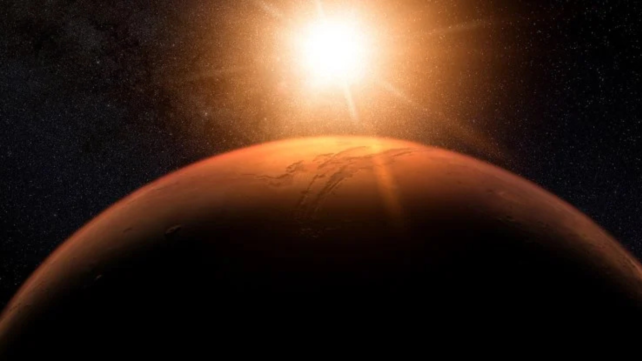
Mars has undergone some monumental PR shifts over the past few centuries.
Once thought to be criss-crossed with canals created by an untold alien race, it has since been reclassified as still red but overwhelmingly dead.
Newer research has shown our smaller neighbor was once tantalizingly watery and habitable, and we now know it's all sorts of active, awash in green aurorae (which we may one day personally glimpse), surprisingly recent lava flows, and some real rattling marsquakes.
Now, the detection of some stinky gas suggests its heart (or gut) is still beating with melty magma.
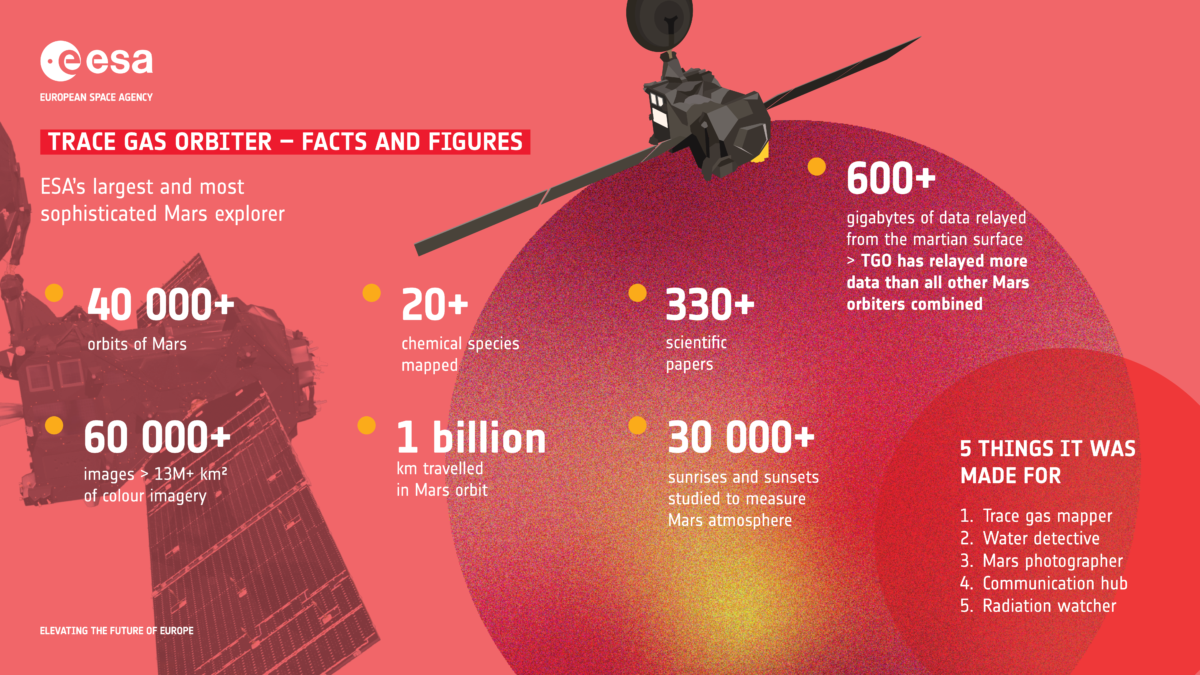
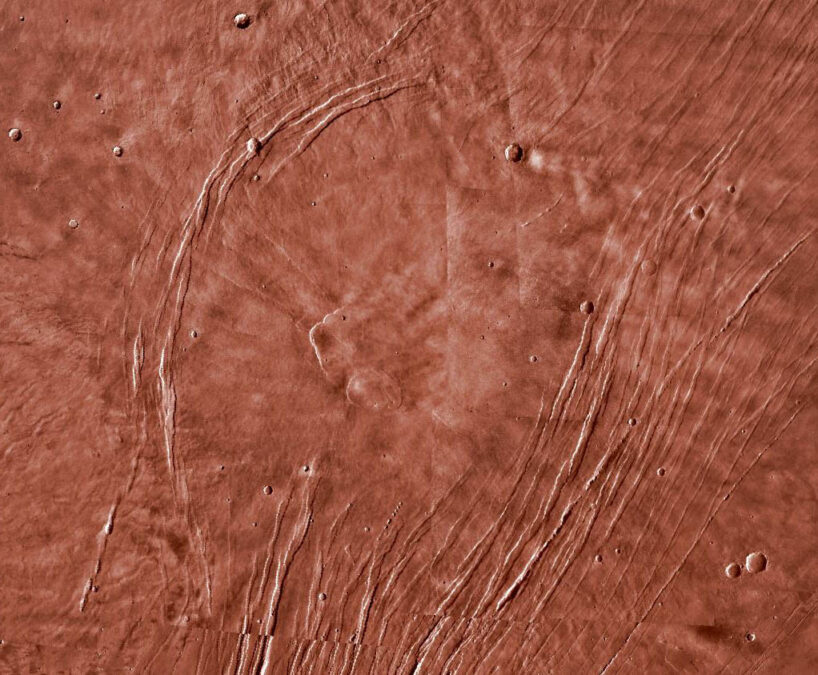
In a new study published in Science Advances, astronomers using the European Space Agency's (ESA) ExoMars Trace Gas Orbiter (TGO) have reported detecting noxious hydrogen chloride (HCl) wafting around Alba Mons, the largest volcano (by surface area) on Mars.
Their discovery hints that our neighbor is still magmatically active in its interior.
"Our results are best explained by ongoing igneous processes in the Martian interior," the researchers say in the study.
A process known as the chlorine cycle occurs on Earth as well, beginning during the early days of planetary formation as chlorine escapes from the interior, and is then fed by subsequent volcanism.
Since chlorine is mobile and readily dissolved, it gets around significantly, 'hooking up' with, and being recycled within, numerous materials like sediments, water, permafrost, and ice clouds.
It's known that Mars was very volcanically active in its adolescence, 3.7 to 3 billion years ago, during its Hesperian era, and later forged the biggest volcanoes in the Solar System, including Olympus Mons – which itself may have shown recent activity only around two million years ago.
Multiple regions of the red planet show signs of recent volcanic activity over the past tens of millions of years, and hot mantle plumes could be melting parts of the Martian interior even today.
Yet thermal signatures, surface features, and sulfurous gases and their products have remained hard to come by or inconclusive.
Enter HCl, which continues to seep from magma even after eruptions have ended. Elevated chlorine ratios, compared to Earth, have also been detected in Martian meteorites, rocks, and regolith.
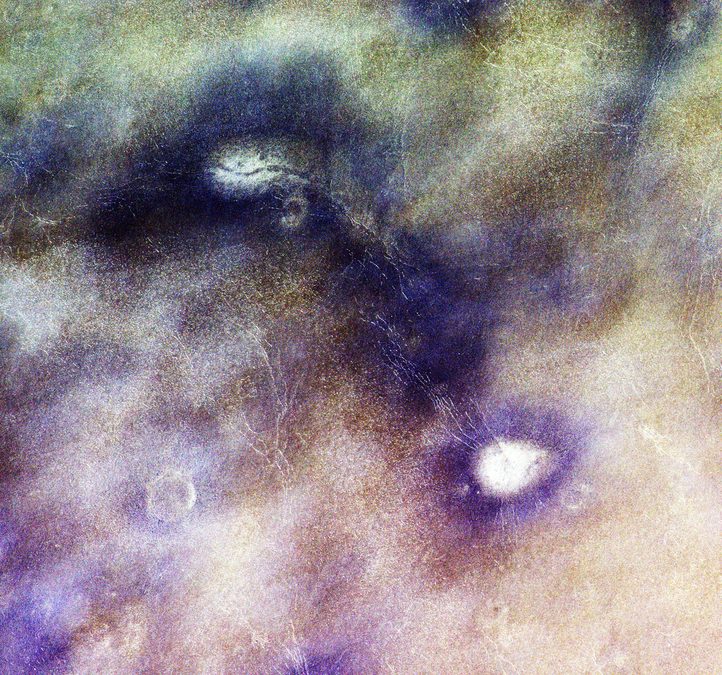
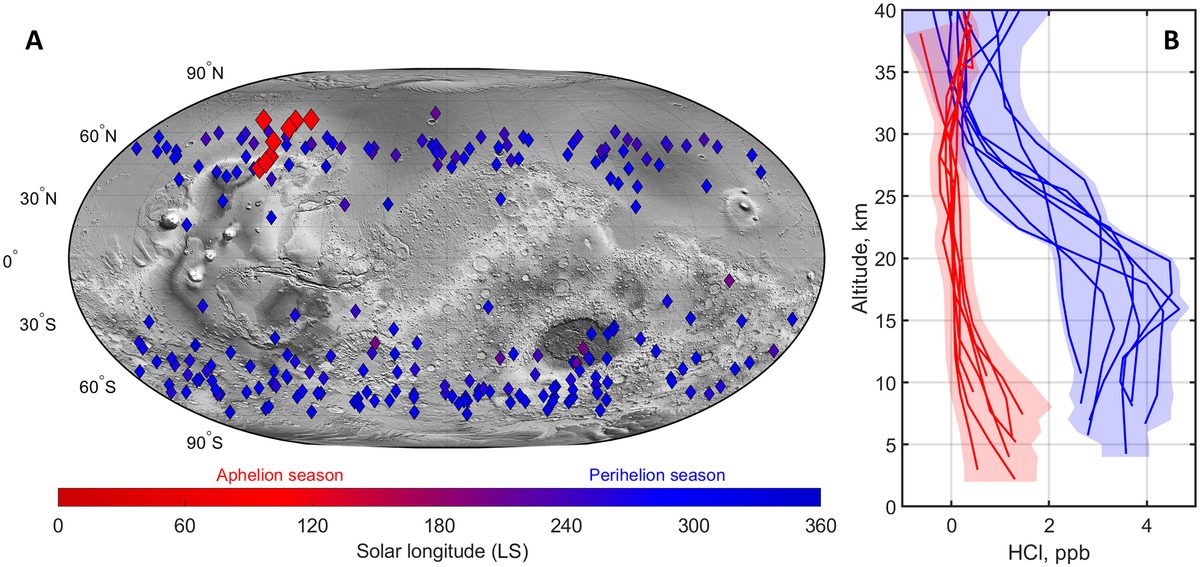
The researchers report multiple HCl detections above fissured ground near the Alba Mons volcano in Mars' northern Tharsis Plateau, a region of recent, perhaps even ongoing subterranean activity.

Scientists have detected many HCl signals across Mars at various seasons of the Martian year, but many of these seem to be associated with Mars' hydrological and atmospheric processes.
However, a handful of HCl signals seem to seep from within the planet's potentially still-molten bowels. These intriguing signals appear in early summer in the northern hemisphere, when Mars is near aphelion, its farthest point from the Sun.
This northern summer is different from the southern summer. It's colder, and the atmosphere is clearer of dust and water vapor. This means that the HCl signals are more likely to be of magmatic origin, rather than the result of atmospheric aerosols. Accordingly, they do appear to emanate at lower altitudes.
The early summer warming sublimates the overlying ice, allowing the HCl to escape from cracks leading to the Martian interior, which may otherwise be frozen over during cold snaps that plunge to -120 degrees Celsius (-184 degrees Fahrenheit).
"The Trace Gas Orbiter was able to find the smoking gun. It was like looking for a needle in a haystack," explains co-lead author Daniel Mège, a planetary scientist at the Space Research Centre of the Polish Academy of Sciences.
"It's truly amazing that it spotted a handful of molecules from a perhaps intermittent source, whilst moving continuously along its orbit to monitor the whole Martian atmosphere."
Indeed, these stinky signals are thin, with ghost-like concentrations in parts per billion. This is like picking the single pear jellybean from a sea of a billion licorice-flavored ones, possibly overturned during a factory-floor fiasco – or one drop of ink in a 10,000-gallon swimming pool.
The researchers advance three potential non-atmospheric causes for the HCl detections.
First, they could be of deep volcanic origin.
Second, they could be due to mud volcanoes, which may release HCl as they bubble from the planetary bowels if they interact with magma, again supporting a volcanic source.
Third, they may be explained by decomposition of chlorine-containing compounds on the surface.
However, the researchers say that a local, igneous source may provide the best explanation.
Especially as the HCl is linked to small fissures that sometimes form "swarms" stretching for tens of kilometers, occasionally ringed with dark-colored halos, perhaps similar to those around fumaroles on Earth.
If not for something maintaining these fissures, they would have disappeared eons ago under accumulating dust or seasonal landscape deformations. Intriguingly, they may be the chimneys of hydrothermal systems connected to a "volcanic plumbing system" deep within Mars.
Of course, this has implications for the most essential question of all, as melting magmas could provide heat and nutrients for extraterrestrials.
"Looking for Martian life in the seeping fissures of the Alba Mons region would make a lot of sense," Mège concludes.
"If hydrothermal systems are active, they could contain the ingredients and energy needed for microorganisms to develop, and shield microorganisms from the hostile and changing environment above the surface."
The research has been published in Science Advances.
This article was fact-checked by Rebecca Dyer and edited by Rebecca Dyer. While we pride ourselves on our process, we are only human. If you spot a mistake, please let us know.