Many things scattered throughout the Milky Way flicker, glow, and pulse in idiosyncratic ways.
From the staccato static of a pulsar to the sudden eruption and slow fade of light from a nova, astronomers have a good handle on the various transient changes cosmic objects undergo.
It would be a mistake, however, to think the catalog of sidereal shenanigans is complete.
And astronomers have now observed an object behaving in ways that no one has ever seen before.
It's called VT J1906+0849, located out beyond the Milky Way's outer Norma-Cygnus spiral arm, and changing in blazing radio light.
The hinky part? Whatever is powering the object seems to operate on a timescale of decades.
"The source," astronomers write in a paper led by Jessie Miller of the California Institute of Technology, "is a distant Galactic synchrotron transient that has remained radio-bright for approximately two decades while exhibiting an evolving spectral turnover frequency and little apparent expansion."

Most changing objects astronomers detect in the night sky transform on relatively short timescales, from milliseconds to months. This has a lot to do with technology – the way we observe the sky, and how long we've been doing it in detail.
In the 1990s, many large-scale surveys began looking more closely at the whole sky, and in the years since, many others have joined the party.
VT J1906+0849 first came to astronomers' attention in data collected in 2017 as part of the Very Large Array Sky Survey (VLASS). There, at least 49,000 light-years from Earth, out beyond the galaxy's spiral arm, was the brightest radio transient the survey had discovered.
At around 70 millijanskies, it was an extraordinarily bright radio transient, especially at such a great distance.
That, naturally, raised questions: What the heck was it, and had it been overlooked in previous survey data?
Thus began the scurry so familiar to astronomers – looking for other observations that covered the same patch of the sky, then seeing what their source looked like in those observations.
There were several radio surveys that had covered the same patch of sky prior to the 2017 VLASS observation.
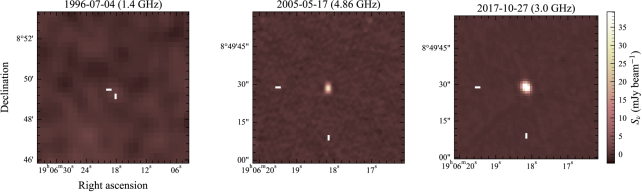
In 1996… there was absolutely nothing to be seen at the site in data collected as part of the NRAO VLA Sky Survey.
But by 2005, that had started to change.
Over the course of several surveys that observed the object between 2006 and 2013, it showed an overall brightening – reaching a peak of around 200 millijanskies in 2014.
The 2017 detection seemed to have caught VT J1906+0849 as it was fading from that peak, but the overall light curve was so weird that the only sensible course of action was to see what it would do next.
The researchers obtained follow-up observations in 2019, 2024, and 2026, with additional observations in 2025 that managed to include VT J1906+0849's corner of the sky. And for a while, it looked as though VT J1906+0849 was winding down. The 2019 and 2024 observations showed it growing progressively fainter.
Then, in late 2025, it went PSYCH.
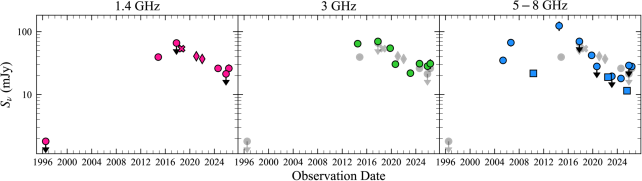
In data obtained using the Very Large Array, astronomers observed VT J1906+0849 growing brighter once again.
So far, so weird. But that's not even the weirdest thing.
Astronomers can infer a lot about a radio source by studying how brightly it shines at different wavelengths on the radio spectrum.
In the case of VT J1906+0849, the radio emission rises to a peak at a particular frequency before dropping off again. But that peak doesn't behave.
In 2019, it was at around 1.9 gigahertz. By 2024, it had shifted down to around 0.8 gigahertz. But by 2026, it had climbed back up to around 2.2 gigahertz. (The spectral peaks for 2014 and 2025 were not well constrained, but both appeared to occur at substantially higher frequencies.)
It's not unusual for a brightness peak to move, but it usually does so in a specific way for specific radiation. The researchers believe this object's radio-wave emission comes from energetic charged particles moving through magnetic fields via synchrotron radiation.
If the source were simply an expanding cloud of material, as is often the case for synchrotron emission, its changing radio spectrum would be expected to follow a more predictable pattern, with the peak shifting toward lower frequencies as the cloud spread out.
But VT J1906+0849 doesn't seem to be spreading out much.
In spite of the dramatic changes in its brightness and radio spectrum, the researchers found little evidence that the source had expanded over several years of observations.
And the sudden shift back toward higher frequencies suggests something rather more complicated than a cloud of energetic particles simply cooling and dispersing.
Combined with the rebrightening, the clues suggest that, whatever VT J1906+0849 is doing, it's an ongoing process.
There are several possibilities, but three are particularly interesting.
One thing that can brighten and then fade over time is an explosion such as a nova – but the ejected material should show signatures of expansion, even if the timescale made sense, which it does not.
Another option is a pulsar-powered nebula, but the dancing frequency peak is too chaotic.
That just leaves the third option, and it's a common suspect in many cosmic mysteries: A black hole doing snacking crimes. Or a black hole or neutron star accreting material from a binary companion, if you want to be all straitlaced about it.
If it is a compact object having a nosh, however, it's doing a remarkably good job of concealing the evidence. Observations using NASA's Swift telescope failed to detect a hint of the powerful X-rays expected from such an accreting system.
But a non-detection doesn't necessarily mean a non-emission. And there's another object in the Milky Way that might offer a final, crucial clue.
SS 433 is an object located around 18,000 light-years from Earth, and it's extremely guilty of weirdness. It's thought to consist of either a black hole or a neutron star, orbiting with a companion star every 13 days.
But the really interesting thing about SS 433 is what happens to the material being pulled away from the companion star.
Some of it falls onto the compact object, but much of it is flung back into space as powerful jets and a dense wind from the disk of material swirling around the central object.
That wind can also obscure the X-rays produced by the accretion process, hiding some of the evidence of what is happening at the heart of the system.
The researchers think something similar might be happening with VT J1906+0849.
If a compact object is continuously launching a jet of energetic particles into a dense surrounding wind, the interaction could produce the strange, changing radio emission while preventing the emitting material from expanding freely.
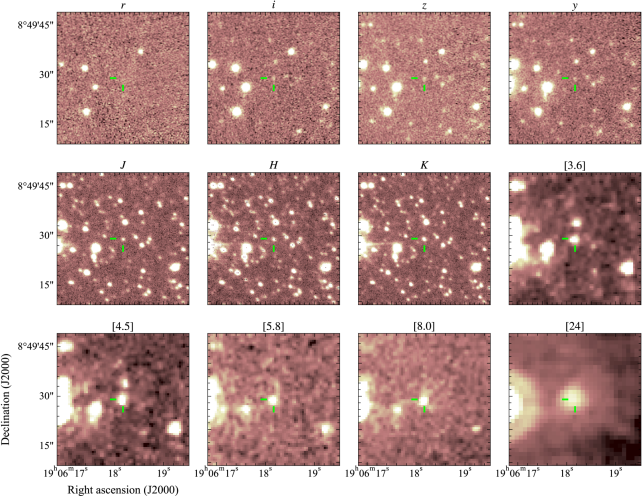
It could also explain the missing X-rays. And there's another clue: infrared observations of VT J1906+0849 revealed evidence of gas moving at around 2,000 kilometers per second, consistent with a powerful outflow.
It's a compelling possibility, but far from a confirmed identification. More observations will be needed to determine whether VT J1906+0849 really is a younger relative of SS 433, or something even stranger.
Still, it's a satisfying answer to a strange sequence of problems, and a message to microquasars everywhere. You might think you got away with it… but astronomers are wising up to your game.
"VT J1906+0849," they write, "highlights the potential for wide-field radio surveys to uncover a population of obscured Galactic accretors that are difficult to identify at other wavelengths."
Mwahahaha.
The research has been published in The Astrophysical Journal.
This article was fact-checked by Rebecca Dyer and edited by Rebecca Dyer. While we pride ourselves on our process, we are only human. If you spot a mistake, please let us know.