Scientists have to follow the data, even if it doesn't make sense.
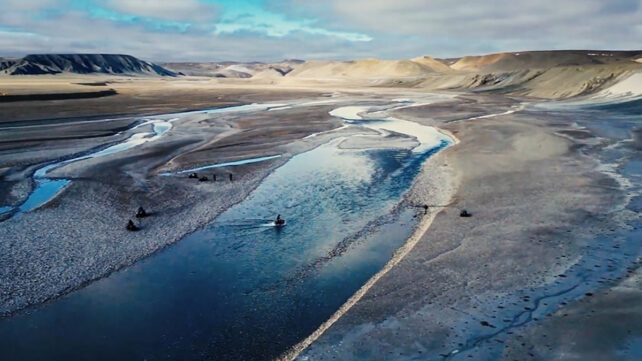
This is the situation that researchers recently found themselves in when analyzing the flow of rivers in the Canadian High Arctic.
Scientists from Simon Fraser University and the University of British Columbia in Canada were investigating river erosion.
Their starting point was the idea that frozen ground slows erosion, as the ice packed inside it was thought to act like glue, keeping the surrounding sediment locked in place.
However, field recordings have suggested something else is going on: That new river channels in the Arctic can form surprisingly quickly, suggesting erosion may actually outpace that in temperate landscapes.
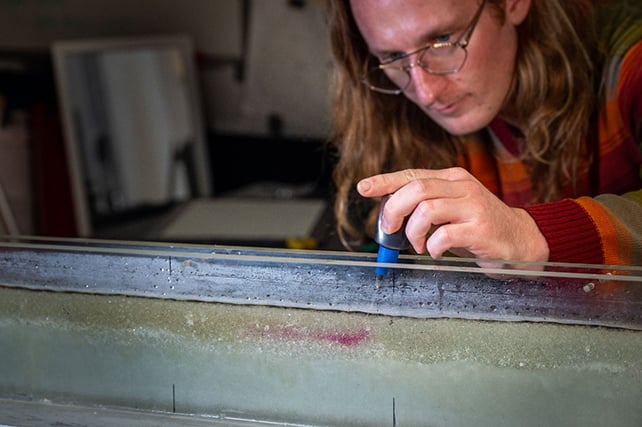
In controlled lab experiments, the researchers found that, to their surprise, this was the case.
Sediment erosion was around 10 times faster than what would be expected with unfrozen ground – findings that defied what they thought they knew about river erosion.
"We literally expected to see the opposite of what we ended up seeing," says environmental scientist Jonas Eschenfelder from Simon Fraser University.
"We re-ran the experiments a whole bunch of times until my supervisor actually believed the results."
In the lab, the team built a glass-sided 'flume' tilted at an angle, measuring 120 centimeters (47.2 inches) in length and 2 centimeters (0.8 inches) in width. Inside the channel, glass beads stood in for river gravel.
When testing frozen water over both frozen and unfrozen sediment beds, the surprising erosion results appeared. What had previously been strange anomalies in the field were being replicated over and over again.
"We saw the results, we looked at ourselves, we said, 'this can't be correct'," says environmental scientist Shawn Chartrand, from Simon Fraser University.
"I emailed some colleagues. They didn't believe me. We ran a second experiment. Same outcome."
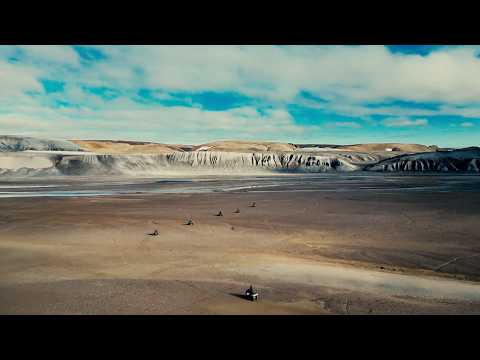
The researchers developed mathematical models to help explain what they were seeing, based on the movement of beads and water in their simulation. They also traveled to the Arctic island of Tallurutit (Devon Island) to put their models to the test.
Here's what seems to be happening: During times when the ground is fully frozen, the erosion is limited, as expected. Nothing can move.
However, as seasonal thawing begins, a shallow layer of sediment melts while frozen ground remains beneath it.
Running water can't go down through the remaining permafrost, so instead it splits off in different directions, taking more sand and soil particles with it. That explains the accelerated erosion recorded in this study.

"You think you understand the basics of how things work, but it doesn't work that way sometimes," says Chartrand.
This is vital knowledge to have as researchers try to understand and predict what's going to happen to the Arctic region as climate change continues, and as more ice disappears from a landscape that's been frozen for thousands of years.
In the researchers' words, the Arctic is "waking up" as temperatures rise, and that awakening includes the appearance of more river systems.
Potential next steps include more detailed field recordings in the Arctic, spread across the entirety of the year and under different temperature conditions, to confirm the accelerated erosion process that's happening.
Related: The Arctic Has Entered a New Era of 'Extreme Weather', Scientists Warn
"The Arctic is becoming an increasingly important place, in terms of geopolitics, environmental concerns and infrastructure projects," says Eschenfelder. "But we clearly don't really know how it is behaving with climate change.
"Our science tries to bridge that gap so we can project future conditions and answer questions about how the landscape is evolving."
The research was published in Communications Earth & Environment.
This article was fact-checked by Peter Dockrill and edited by Peter Dockrill. While we pride ourselves on our process, we are only human. If you spot a mistake, please let us know.