There's no proof of other life beyond Earth yet, but scientists are constantly looking out and listening for signs that we're not actually alone in the Universe.
Now, a team from the Center for Astrophysics Harvard & Smithsonian and the University of Oregon has announced an important first: A radio signal coming directly from an exoplanet (a planet outside the Solar System).
Previously, radio detections in planet-hosting systems couldn't be unambiguously localized to the planets rather than the stars they're circling.
However, this isn't aliens trying to get in touch.
It's the signal coming from the exoplanet's auroras, created by charged particles interacting with atmospheric and magnetic field conditions to release energy. Earth has auroras too, which show up as the northern and southern lights.
"Although auroral radio bursts are observed in Solar System planets and in some ultracool dwarfs, no radio detection has previously been unambiguously localized to an extrasolar planet rather than its host star," write the researchers in their paper.
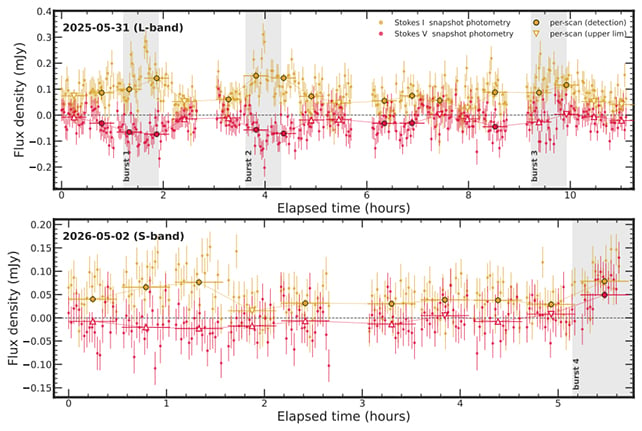
"We detect rapid, recurring, and highly circularly polarized bursts, as well as persistent emission, at frequencies of 0.85 to 3.5 GHz."
Those are the frequencies that the researchers covered using the MeerKAT radio telescope array in South Africa, across four separate occasions in 2025 and 2026.
The focus of the telescope array's attention was the star Beta Pictoris, about 63.4 light-years away, and with three known planets around it: Beta Pictoris b, Beta Pictoris c, and Beta Pictoris d.
What came through from the observations were short, repeating radio bursts, with the radio waves strongly circularly polarized. That's a classic signature of signals emitted from auroras.
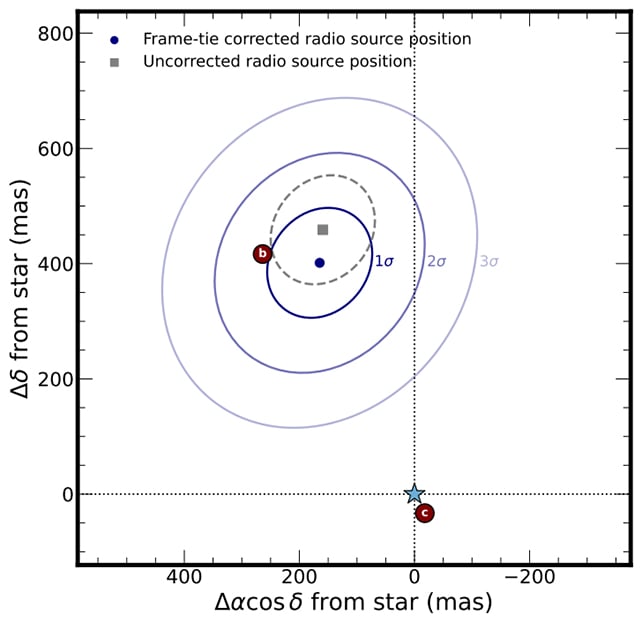
Using super-bright galaxy cores called quasars as reference points in their sky map, the researchers were able to ascertain with a high degree of certainty that it was planet b, and not the Beta Pictoris star, sending out the broadcasts.
Beta Pictoris is an 'early-type' star, which means it's hotter, bigger, and structurally different to stars like our Sun.
"No physical mechanism known to cause radio emission in early-type stars can explain the observed emission," write the researchers.

The researchers go on to demonstrate just how useful it is to isolate a radio signal like this. Its characteristics point to an Electron Cyclotron Maser Instability (ECMI), which is the same process that produces auroras on Earth and Jupiter.
What's more, ECMIs provide clues to a planet's magnetic field too.
It seems Beta Pictoris b has a particularly strong magnetic field, which fits in with previous modeling of the planet and its dynamo (the internal processes that generate the magnetic field).
"This constitutes the first direct measurement of magnetic field strength for an exoplanet, and is consistent with dynamo-scaling predictions for a young, massive giant planet," write the researchers.
The researchers calculate planet b has a very strong magnetic field, thousands of times stronger than Earth's, with its auroral radio emission possibly powered by its rapid rotation (the planet only takes 8–9 hours to spin around).
Beta Pictoris b was first discovered back in 2008 and is huge – roughly around 10 times the mass of Jupiter.
Now it also has the distinction of being the first exoplanet that we've detected a clear radio signal from.
Related: Flash From Nearby Galaxy Brightest of Its Kind Ever Seen
Now the researchers have their eyes on other planets. Specifically, seven other known giant exoplanets across five nearby star systems, which could potentially soon be analyzed in the same way Beta Pictoris b has been.
"A ∼5x to 7x improvement in instrument sensitivity, expected from next-generation radio observatories, will bring them within reach of detection," write the researchers.
The research has yet to be published in a peer-reviewed journal, but is available online at arXiv.
This article was fact-checked by Peter Dockrill and edited by Peter Dockrill. While we pride ourselves on our process, we are only human. If you spot a mistake, please let us know.