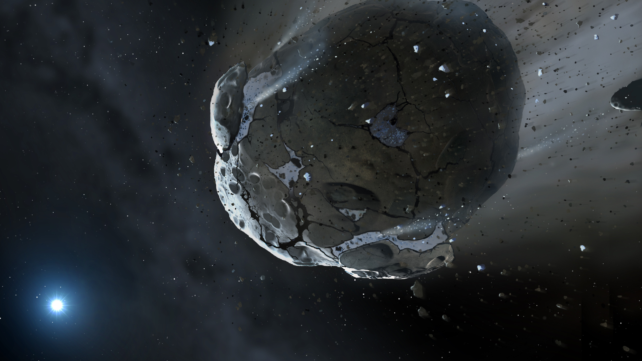
The Solar System is a soggy sort of place.
Although most of Earth's surface is covered in liquid water, it's a mere drop in the ocean compared to the entire volume contained in the Solar System – much of it locked away as ice in the moons of the giant planets.
The outer Solar System is icier still. Far from the warmth of the Sun, the estimated millions of icy objects that make up the Kuiper Belt beyond Neptune are thought to contain absolute scads of the stuff.
And now, scientists have found evidence that at least some of that distant water is of a kind singularly unlike the water we have here on Earth.
In a handful of dust grains that traveled to Earth from the Kuiper Belt, traces remain of long-lost water bearing the signature of primordial chemistry – suggesting that the water reservoir at the edge of the Solar System remained pristine, untouched by the changes unfolding closer to the Sun.
It is, according to a study led by planetary scientist Lindsay Keller of NASA's Johnson Space Center, "compelling evidence for the presence of a major heavy water reservoir beyond the orbits of the gas giant planets that was largely isolated from inner solar system materials."

The Kuiper Belt beyond Neptune's orbit at roughly 30 astronomical units from the Sun – 30 times the Earth-Sun distance – represents a somewhat challenging Solar System frontier.
Very few human-made craft have ventured into its cold, dark reaches.
It takes years to get there; landing a probe or collecting samples to send to Earth would be so astronomically difficult and expensive that – so far at least – it's out of the question entirely.
This is kind of a bummer, because the chunks of ice and rock hanging out in the Kuiper Belt are thought to be among the most unchanged remnants of the early Solar System since it all coalesced out of solar amniotic dust and gas some 4.5 billion years ago.
Luckily for us, though, not everything in the Kuiper Belt stays there.
We can't see it, but the Solar System is full of cosmic dust. An estimated 5,200 metric tons of the stuff rains down on Earth every year. And some of that dust has traveled a long, long way to get here.
Keller and his colleagues found 12 such grains, each measuring 10 to 30 micrometers across, in materials collected from the stratosphere by high-altitude NASA aircraft.
Ah, but this raises an interesting and important question: how can you tell that a micron-scale speck of dust scooped from Earth's stratosphere came all the way from beyond Neptune's orbit?
In the Solar System, it's all about travel scars. In interplanetary space, there's no atmospheric protection from the powerful radiation streaming from the Sun – and solar energetic particles don't leave exposed dust unscathed.
As it passes through a speck of dust, solar energetic particles can knock atoms slightly askew in their crystal lattice structures, leaving a telltale trail in their wake – a bit like a charged particle leaving a trail in vapor in a cloud chamber, although the mechanisms are different.
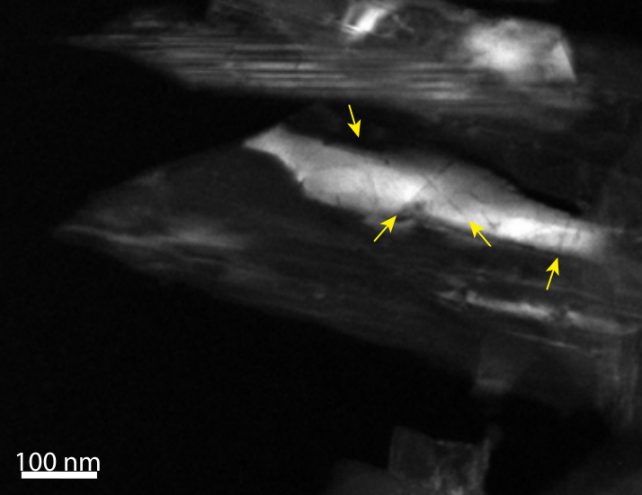
The more such trails a mineral has accumulated, the more time it has spent drifting in interplanetary space. And it's pretty reliable. Dust orbiting the Sun experiences something called the Poynting-Robertson effect – a very slight drag exerted by sunlight, causing the grains to gradually lose energy and spiral inward towards the Sun.
So scientists can count the radiation tracks and work out whether a grain has spent enough time in space to have traveled from the distant reaches of the Solar System.
The grains identified by Keller and his team had track densities around 100 times greater than expected for dust from the asteroid belt or Jupiter-family comets – consistent with an origin from much farther away, as far as the Kuiper Belt.
The mineral composition of the grains offers another clue – and, as the researchers found, holds the secret of the ancient water they encountered.
The grains were extraordinarily rich in carbon, containing around four times as much as certain carbonaceous meteorites – another indication that they formed under different conditions, far from the Sun.
But there was something else in the grains that yielded a particularly tantalizing clue about their history – clay.
Many of the grains contained clays such as saponite and serpentine, as well as other hydrated minerals that form when water reacts chemically with other minerals, altering their composition.
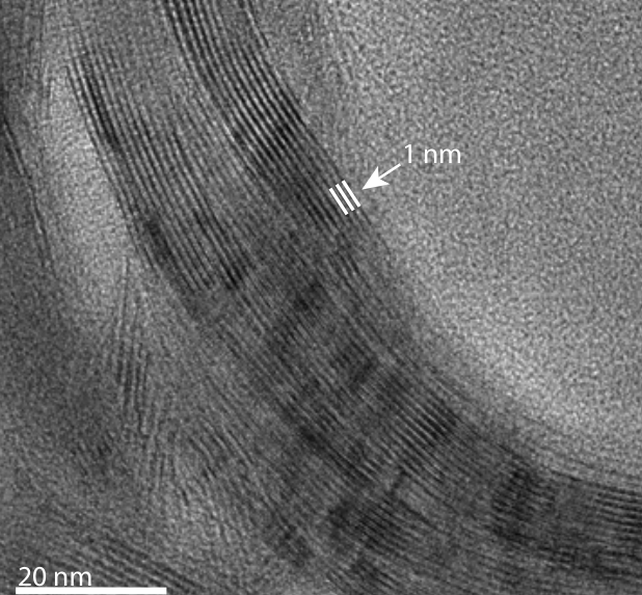
This means that, at some point in the distant past, liquid water must have existed inside the parent bodies from which the dust grains originated.
Although the Kuiper Belt is frozen today, radioactive decay or heat generated by collisions could once have warmed the interiors of some of its icy objects enough to melt water, allowing it to react with the surrounding rock.
That water is long gone, but the minerals in the 12 grains retained some of the oxygen that was once part of its molecules. And that's where things got very not-from-around-here.
Oxygen comes in several varieties, called isotopes, which differ in the number of neutrons in their atomic nuclei. The most common by far is oxygen-16, with eight protons and eight neutrons. But there are also two heavier, naturally occurring stable isotopes: oxygen-17, with eight protons and nine neutrons, and oxygen-18, with eight protons and ten neutrons.
The relative proportions of these isotopes can vary depending on where and how a material formed, leaving a sort of chemical fingerprint of its history.
When Keller and his colleagues measured the oxygen isotopes in the dust grains, they found an unusual enrichment in the heavier varieties.
By reconstructing the chemical reactions that formed the hydrated minerals, the researchers were able to estimate the isotopic composition of the water responsible.
They found that the minerals inherited the heavier oxygen isotopes from water that must have been unusually rich in them – preserving the signature of an ancient reservoir that existed in the outer Solar System billions of years ago.
The isotopic signature was distinctly different from that of water inferred from carbonaceous meteorites, which formed in other regions of the early Solar System.
This suggests that the water in the distant Kuiper Belt belonged to a separate reservoir that had remained largely isolated from the mixing and chemical changes taking place closer to the Sun.
And the researchers have an idea about what might have kept it that way: the giant planets.
You're nodding to yourself now, thinking, yep, that sounds like Jupiter. But this time, it is Saturn acting as the goalkeeper, keeping the outer Solar System's primordial water from crossing into the inner Solar System.
Models of the early Solar System suggest that Saturn could have created a pressure bump in the disk of gas and dust surrounding the young Sun, slowing or even stopping material from drifting inward.
Together with the ice giants, Saturn may therefore have helped preserve a reservoir of water with an isotopic signature distinct from the material circulating closer to the Sun.
Scientists have long suspected that such a reservoir of heavy-oxygen-rich water existed in the early Solar System, but evidence of it has been remarkably difficult to find.
Most of the meteorites available for study come from regions where extensive mixing and chemical alteration have obscured the original isotopic signatures.
But this evidence may have been drifting right under our noses this entire time.
Twelve grains may not sound like a lot… until you consider how far they must have traveled, and how they were collected. In a 2022 paper, Keller and coauthor George Flynn of the State University of New York estimated that as much as a quarter of the interplanetary dust entering the inner Solar System may have traveled from the Kuiper Belt.
Somewhere in the constant rain of cosmic dust that falls to Earth may lie countless other fragments of the Solar System's earliest history, scarred from the journey and carrying secrets that have survived billions of years to end up in your roof gutter.
The research has been published in Science Advances.