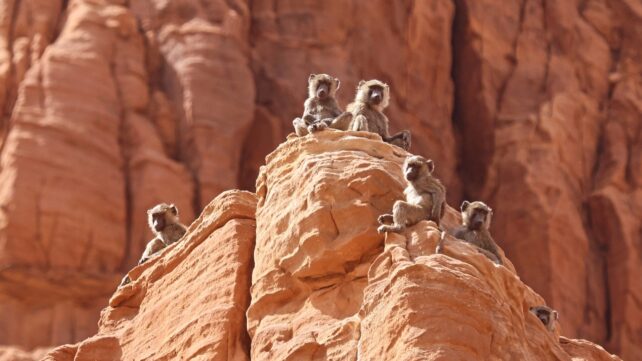
Scientists have long believed birds of prey were incapable of grabbing large primates, but new evidence stands to break that rule.
A unique population of olive baboons (Papio anubis) lives in the Ennedi Plateau, a massive outcrop of sandstone in the middle of the Sahara Desert, in Chad.
"Some of the baboons there are so remote they rarely, if ever, see people," primatologist Catherine Hobaiter says.
Hobaiter is a member of the Wild Minds Lab at the University of St Andrews in Scotland. She is also part of the team that went looking for the Ennedi baboons, in what may be the first scientific effort to understand the remote population.
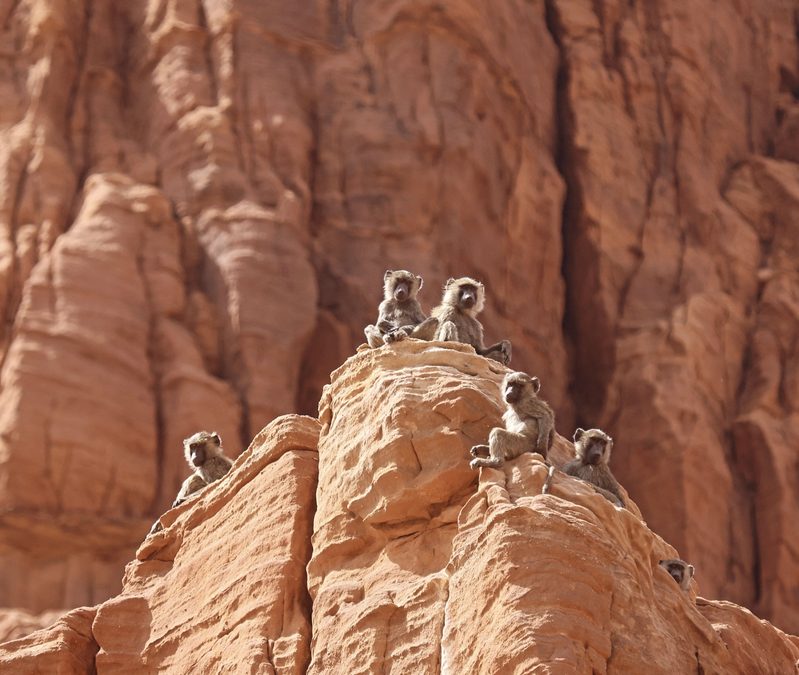
The Ennedi Plateau contains a large reservoir of water called a guelta. As a result, animal life in the area is surprisingly rich for this otherwise barren location.
The video below shows Ennedi Plateau's patas monkeys, not the olive baboons, but it illustrates the habitat well.
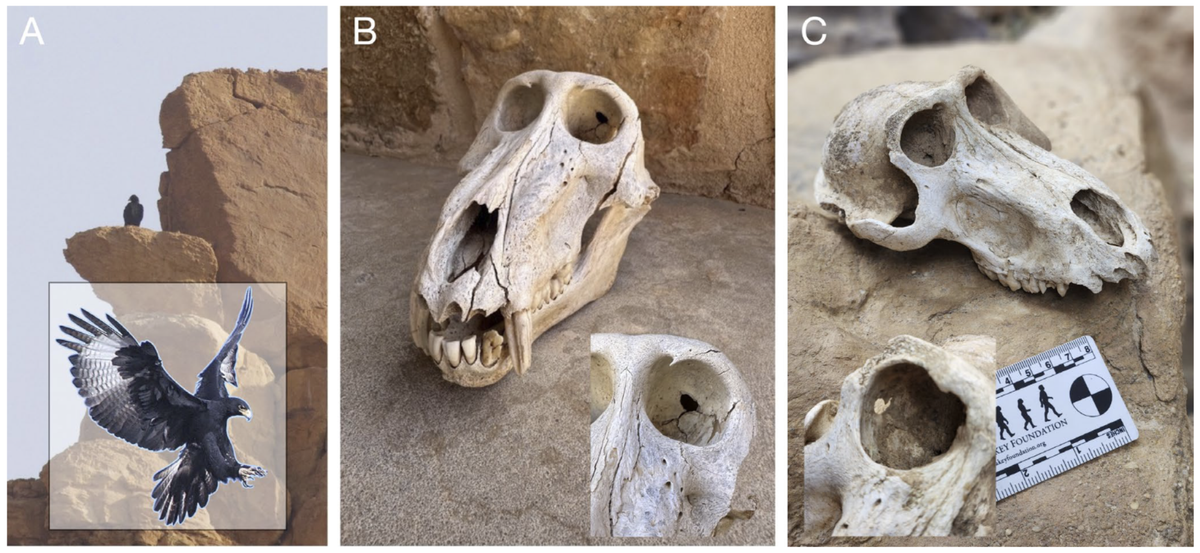
In their search for the baboons, the researchers often noticed Verreaux's eagles (Aquila verreauxii) flying overhead, but thought little of them.
"We never imagined that they might be a threat [to the baboons]," Hobaiter says.
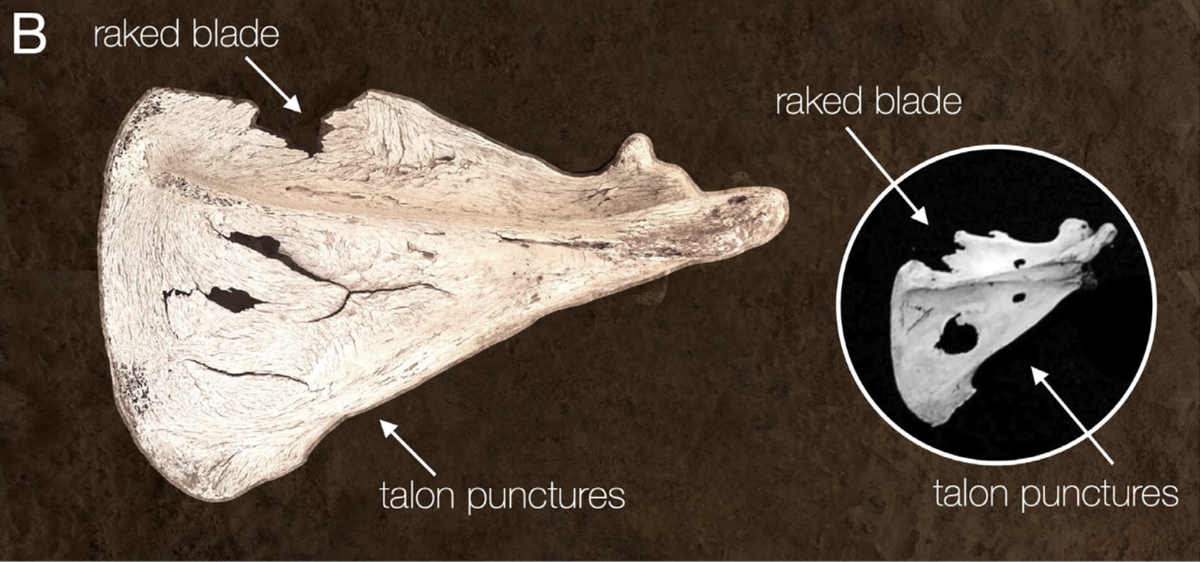
But while walking around the bottom of the sandstone cliffs, the team encountered something that drew an invisible arrow between the birds and the primates: baboon skulls and bones marked with talon-shaped perforations and scrapes from an aerial predator.
"We found the first skull with a puncture mark, and then another, and another," Hobaiter says.
These were the unmistakable signs of a raptor attack.
Conservation biologist Jean Didier Akpona, who works for African Parks, regularly observed Verreaux's eagles in his three years based in the region.
"I had never imagined that these predators would target primates of this size until the research team stumbled upon evidence," he says.
These were the remains of large male adult baboons, which usually exceed 20 kilograms (44 pounds).
That figure has long been considered an important cutoff for which primates a bird of prey can successfully grasp. The heaviest primate known to have been killed by a predatory bird was less than 13 kilograms.
Paleoanthropologists and primatologists have adopted that boundary as the basis for theoretical work into the evolution of humans and apes.
But the discovery at Ennedi Plateau might break that underlying rule.
"Possible exceptions are worthy of attention, and it is this possibility that motivates our report from the Ennedi Plateau," the team writes in a paper just published in the American Journal of Biological Anthropology.
Eight of the skeletal baboons had a mean body mass of 22 kilograms, the scientists estimate.
But then, in June 2026, they uncovered another cranium and partial skeleton of an even larger male baboon, again, with the same raptor markings. This individual, they think, would have been about 26.2 kilograms.
"One of the most exciting observations was seeing the baboons respond when a pair of Verreaux's eagles swept overhead," Hobaiter says, adding that primates tend not to react to eagles unless they're a genuine threat.
"We'd seen them very relaxed around other big birds of prey, but as soon as the Verreaux came into view they alarm called and dropped down to safety".
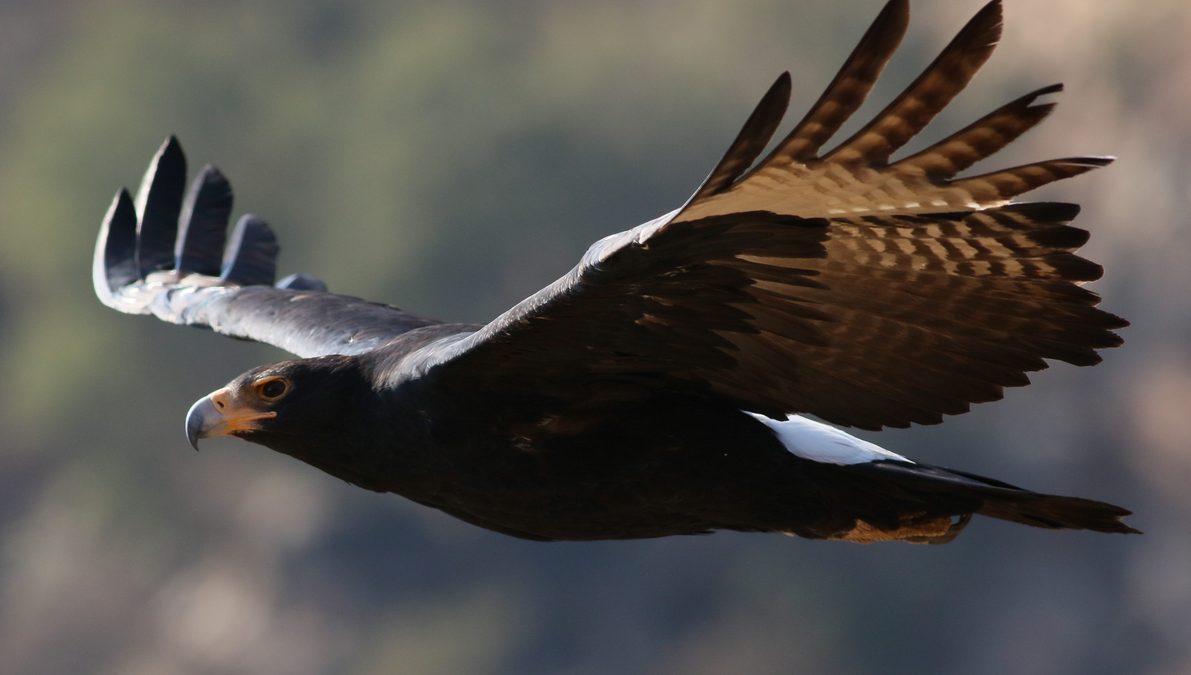
If the team's size estimates hold up, the implications for primate and human evolutionary history are pretty major.
Large adult male baboons are about the same weight as a modern eight-year-old child, and, potentially, some of our ancient hominid ancestors.
Many primates benefit from the protection that group-living gives them against sky hunters like the eagle. If one primate gets grabbed by a raptor, others will 'mob' the bird to drive it away.
Human ancestors may have faced similar threats.
"Baboons are some of the best studied monkeys in Africa, but our very first observations from Ennedi upended all sorts of notions," Hobaiter adds.
"I can't wait to see what new 'rules' they'll break next."
The research has been published in American Journal of Biological Anthropology.
This article was fact-checked by Fiona MacDonald and edited by Fiona MacDonald. While we pride ourselves on our process, we are only human. If you spot a mistake, please let us know.