
The laws of physics at the quantum level can break free from the standard confines of solids, liquids, and gases, and researchers just observed an exotic quantum state of matter – a particular way of particles organizing and behaving themselves.
What's more, it was engineered at room temperature, without the extreme cooling that quantum states usually require.
The results of the experiments, carried out by an international team of researchers, have been published in Science Advances. They point the way to more practical uses of quantum technology in advanced computing systems and sensors.
Part liquid and part solid, the quantum state was created using a tiny light-trapping structure called a microcavity.
As a quantum testbed, the setup has a lot going for it: It's relatively inexpensive, controllable via voltages, and doesn't need a cryogenic fridge.

"Our liquid-crystal microcavities can operate even at temperatures approaching 60 °C (140 °F)," says physicist Wiktor Piecek from the Military University of Technology in Poland.
The technical term for this quantum state is a supersolid in an exciton-polariton Bose-Einstein condensate, which probably needs some breaking down for those of us who aren't quantum physicists.
Two of the states that exist in the quantum realm are superfluids (a liquid that can flow without resistance) and supersolids (superfluids but with a regular, repeating crystal structure rather than a loose, fluid one). That's the supersolid part.
The exciton-polariton is a hybrid quasiparticle (multiple particles acting as one), combining both light and matter. And finally, a Bose-Einstein condensate (BEC) is where multiple particles or quasiparticles become a single quantum entity.
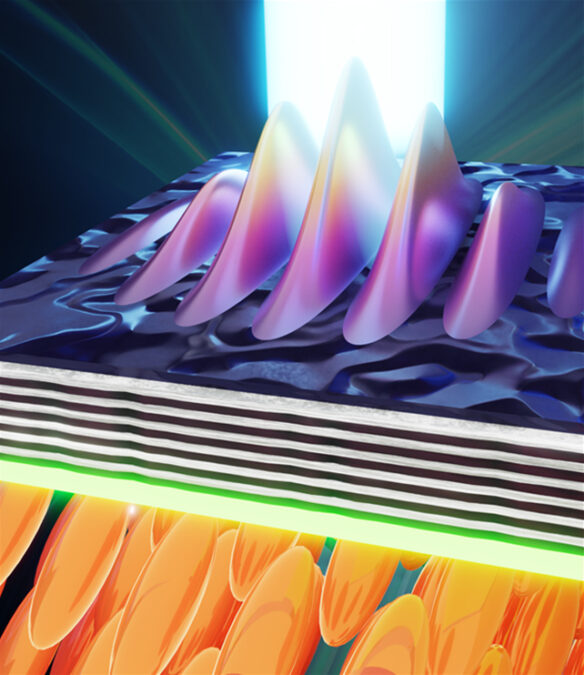
To produce this quantum state, the researchers combined a liquid crystal (which can be controlled by voltage) and an organic semiconductor (which interacts strongly with light). Laser pulses were then used to supply energy for the quantum reaction.
However, the behavior the scientists were looking for was relatively short-lived – the materials degraded over time, as the semiconductor reacted with the liquid crystal.
"We had to plan the entire sequence of experiments in advance," says physicist Marcin Muszyński, from the City College of New York. "Repeating a measurement meant fabricating an entirely new sample."
Further validation of what the researchers were looking at came with each successive laser pulse. The condensate reformed each time, with its stripes – the solid, crystal-like part of the supersolid – lining up in slightly different places with every refresh.
That might not sound like much, but it's evidence of the inherent nature of this quantum state, rather than anything influenced by the external microcavity.
"This is a textbook example of spontaneous symmetry breaking," says physicist Guillaume Malpuech, from the French National Centre for Scientific Research (CNRS).
"Theory predicted that the supersolid could choose among several equivalent states, and that is exactly what we observed."
While the individual particles produced by the researchers only lasted for fractions of a second, it was enough to get the observations they needed. Multiple samples were tested with the same results, which were also backed up by computer simulation models.
Routes for developing the experiments further might involve working on ways to get the core reactions to last for longer, and interrogating in more detail the quantum vortices that appeared – flaws in the stripe patterns that indicated superfluid behavior.
Ultimately, it means an easier method for studying quantum behavior in superfluids and supersolids, without the added expense and complexity of extreme cooling – particularly when it comes to the spin-orbit coupling shown here (the linking of light polarization and motion that created the supersolid arrangement).
Almost any quantum effect involving light, including those related to computer chips and advanced sensors, could benefit further down the line.
"Our work opens new perspectives for quantum fluids of light physics in the presence of spin-orbit coupling and beyond," write the researchers in their published paper.
The research has been published in Science Advances.
This article was fact-checked by Rebecca Dyer and edited by Rebecca Dyer. While we pride ourselves on our process, we are only human. If you spot a mistake, please let us know.