Out beyond Neptune, the Solar System changes.
The familiar domain of the planets gives way to a frozen abyss – a vast chasm of space so far from the warmth and light of the Sun that we have barely begun to catalog its contents.
The conventional view of trans-Neptunian space is one dominated by a vast belt of small, icy objects, more or less following an orderly march around the Sun.
But some of those less orderly orbits may betray the presence of something much larger: a hidden super-Earth out beyond the Kuiper Belt.
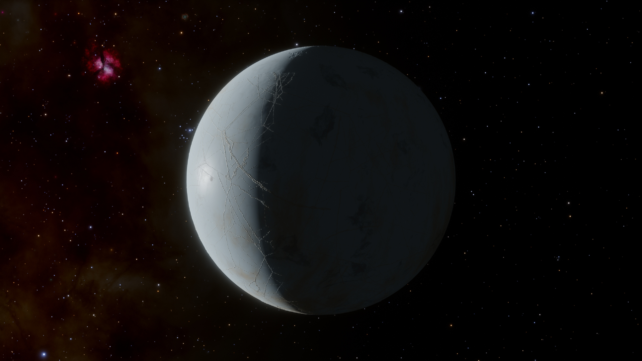
No, not Planet Nine. A second one. A mysterious world astronomers are calling Planet X2.
"It's a bit like the footprints in the snow," planetary scientist Jonti Horner of the University of Southern Queensland in Australia told ScienceAlert. "It's telling you that somebody's been there that you didn't expect."
Much of what we know about the Solar System relies on the light of the Sun, which illuminates the objects herein.
However, by Neptune's distance – an average of 30.1 astronomical units, or 30 times the distance between Earth and the Sun – that sunlight has become 900 times weaker than the light that reaches Earth. And only a tiny fraction of the light reflected off objects at that distance makes it all the way back to our telescopes.
But those telescopes have grown more powerful and sensitive over the decades; and, in recent years, enough objects have been identified in the outer Solar System to begin mapping their orbital distributions.
And it's here that questions have arisen – because, while most of the behavior of the outer Solar System can be attributed to the gravitational influence of the known giant planets, particularly Neptune, some niggling, persistent signals are more challenging to explain.
Some of those anomalies led to the Planet Nine hypothesis. And now, a different pattern in the orbits of distant objects suggests the presence of a second hidden world.
The clues lie in two unusual populations of objects: one whose orbits are tilted at extreme angles, and another whose closest approaches to the Sun are far beyond even the orbit of Pluto.
When you replay the evolution of the Solar System from its infancy and just include the giant planets, you can't reproduce these populations.
"So the question is: Okay, well, if we can't reproduce them with the planets as we know them, what if we add something extra out there, something that is far enough away that we realistically wouldn't have found it yet, and see what happens?" Horner said.
And that's exactly what astronomers Patryk Sofia Lykawka of the University of Southern Queensland and Kindai University in Japan, Pedro Bernardinelli of the University of Washington in the US, and Horner set out to do.
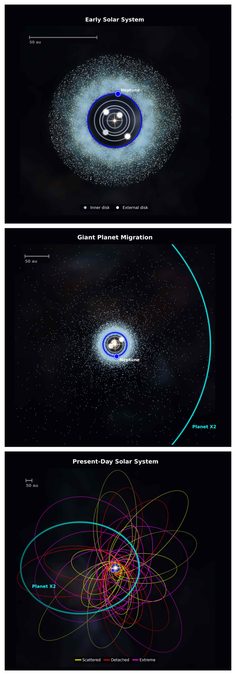
The team ran detailed computer simulations spanning 4.5 billion years, tracing how the outer Solar System evolved as the giant planets migrated into their present positions.
They compared models containing only the four known giant planets with models that included an additional, distant planet, examining the populations of icy objects that emerged.
With that extra planet in the mix, something interesting happened. The simulations began producing populations of objects on highly tilted and detached orbits that more closely resembled the unexplained orbits astronomers have actually observed.
The closest match is tantalizing – a planet around 1 to 2 times the mass of Earth, on a distant orbit with a semimajor axis of 350 to 500 astronomical units. It would never get closer to the Sun than 200 astronomical units.
"If this planet exists, it could change how we understand the history of our Solar System and how its most distant objects came to follow such unusual orbits," Lykawka says in a statement.
Similar orbital patterns are the breadcrumbs leading to Planet Nine, which, according to a 2025 analysis, has an estimated mass of about 4.4 Earths, and a semimajor axis of around 290 astronomical units.
Here's the really fun bit. The two hypotheses seek to explain different orbital patterns, which means the Solar System could potentially accommodate both.
"It is possible that there could be neither. It's possible there could be both. It's possible there could be one or the other," Horner said. "It is entirely in keeping with what we're learning about planetary systems around other stars that there could be things further out."
That probably sounds like two planets too many to have overlooked – they're not exactly tiny. But those other planetary systems hold clues about how they could have ended up out there.
Because planets don't necessarily stay where they are born – in fact, there are many clues throughout the Solar System that significant reshuffling has taken place.
In the early stages of a planetary system's evolution, gravitational interactions between growing worlds can send them migrating inward or outward, sometimes flinging them into distant orbits or ejecting them from the system entirely.
Astronomers have found planetary systems with architectures very different from our own, suggesting that the relatively orderly arrangement of our eight known planets is far from the only possible outcome.
If Planet X2 exists, one possibility is that it formed much closer to the Sun before gravitational encounters with the giant planets scattered it into the distant reaches of the Solar System, where it has remained ever since, making trouble with the trans-Neptunian objects.
The simulations don't offer exact replication, though. While they put forward a promising explanation for some of the Solar System's more peculiar orbital arrangements, they don't account for everything astronomers have observed.
In particular, although the models reproduce several features of the distant objects detected by the Dark Energy Survey, the distribution of their semimajor axes doesn't quite match.
But, given the complexity of the Solar System's evolution, the limitations of computer simulations, and the relatively small number of distant objects observed so far, a perfect match would be surprising.
"This isn't a perfect fit. You wouldn't expect it to be. I'd be more worried if it was, to be honest," Horner said.
"But it's a very, very, very good start, and it is quite compelling."
And the next step is already underway.
The Vera C. Rubin Observatory in Chile is beginning to transform our view of the outer Solar System. Its extraordinarily sensitive telescope will discover vast numbers of previously unseen trans-Neptunian objects, giving astronomers a much larger sample against which to test their models.
If Planet X2 exists, the distinctive orbital populations predicted by Lykawka and his colleagues should become increasingly apparent as more objects are discovered.
And there's even a chance Rubin could spot the planet itself, although Horner cautions that its enormous distance and faintness would make that a much tougher proposition.
Like Planet Nine, the Planet X2 hypothesis will also face scrutiny from other scientists searching for alternative explanations for the orbital weirdness.
"This is one explanation, and you know, I encourage people to try and think of other explanations and test them and make predictions," Horner said. "It's that make predictions thing that I think is so important. It's if this is true, then predict."
The research has been published in Monthly Notices of the Royal Astronomical Society.
This article was fact-checked by Rebecca Dyer and edited by Rebecca Dyer. While we pride ourselves on our process, we are only human. If you spot a mistake, please let us know.