When is a de-extinction not a de-extinction? Some headline-grabbing methods for bringing extinct species back to life fall short of such grand claims, according to a new argument published in Biology Letters.
The case is put forward by marine biologist Andrew Davinack and biochemist Charlotte Daniels from Wheaton College Massachusetts, with much of their attention focused on the so-called 'de-extinction' of the dire wolf by biotech company Colossal Biosciences in 2025.
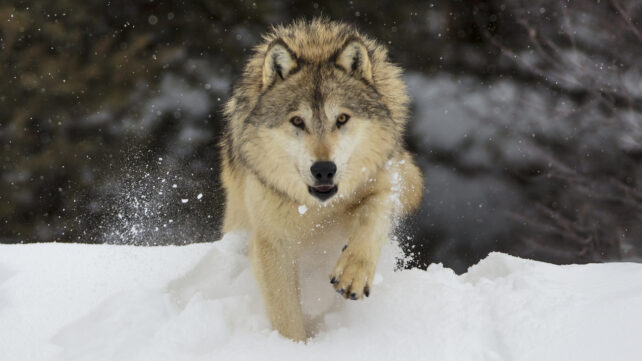
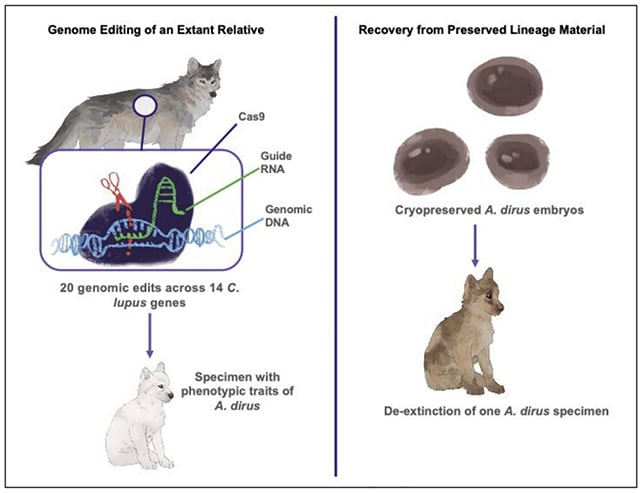
What Colossal Biosciences did was make genetic edits to grey wolf cells in order to breed animals with characteristics that more closely resembled dire wolves – including larger bodies, bigger teeth, and paler coats of fur.
That's actually not a de-extinction, Davinack and Daniels contest, and they've got a new term for the mistake of calling it one: lineage-genome conflation.
"Recent advances in ancient DNA sequencing, comparative genomics and genome editing have renewed interest in de-extinction, often framed as the technological reversal of species loss," write the researchers in their published paper.
"Here, we argue that de-extinction cannot recover extinct species because extinction represents the termination of an evolutionary lineage, not merely the disappearance of genetic information."
There are several parts to the argument. The researchers point out that a species is more than its DNA – that genes and the physical characteristics they result in have been born from a long, continuous, evolutionary history. Any gaps in that history break the connection and redefine the species.
Then we have the issues of habitats and populations. Can just a few engineered animals recreate the variation of a large population, or the historical habitat it was part of? Davinack and Daniels suggest not.
To go back to the dire wolves example, these wolves were living in a very different world to today's more than 10,000 years ago. The climate, food sources, predators, and other environmental connections are no longer around in the modern day – another break that makes the extinction permanent.

"Species are historically continuous population-level lineages shaped by gene flow, mutation, drift, selection, demographic history and ecological interaction," write the researchers.
"A reconstructed genome, even if highly accurate, represents at most a partial snapshot of an individual organism."
The researchers acknowledge that many scientists, and the studies authored by them, are careful not to use terms like 'de-extinction' when they aren't accurate. However, they are asking for private companies and media outlets to be more responsible when reporting these advances in technology.
Terms like de-extinction can be misleading and misrepresent the science involved, the researchers argue, which then makes it harder to put technological progress and new techniques in context.
"Greater precision in terminology therefore has practical consequences," write the researchers. "Lineage restoration, genetic recovery, phenotypic reconstruction, ecological substitution and restoration of historical communities are distinct objectives and require different criteria of success."
The researchers don't go as far as saying de-extinction is impossible, but they do contend that the dire wolves case doesn't qualify. Using preserved cells or preserved embryos is a more promising route for de-extinction, the researchers say – solving some of the problems mentioned above, and ensuring greater "biological continuity".
Scientists used the cell preservation technique with the Pyrenean ibex back in 2003, and although the animal didn't survive, there's a stronger claim to de-extinction.
It's worth pointing out that the researchers aren't arguing that the work done by companies such as Colossal Biosciences is without merit as far as genetic engineering goes – but that we need to be careful when describing and evaluating it.
So, rather than bringing back dire wolves from extinction, what we actually saw in 2025 were grey wolves with some dire wolf traits – not the resurrection of the species.
"Genomic reconstruction may recreate selected traits or produce ecological proxies, but it cannot recover extinct species as historically continuous evolutionary lineages," write the researchers.
The research has been published in Biology Letters.
This article was fact-checked by Fiona MacDonald and edited by Fiona MacDonald. While we pride ourselves on our process, we are only human. If you spot a mistake, please let us know.