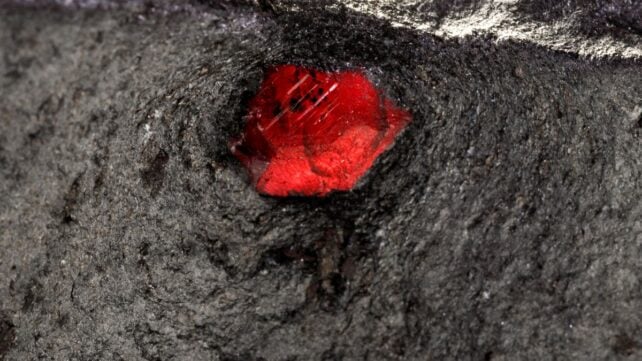
Cracking open a meteorite that landed on Earth from Mars has yielded an unexpected treasure.
Hidden inside a fragment of rock, scientists found a few grains of garnet – a mineral that has never before been found in a Martian sample.
This tiny speck raises some enormous questions.
On Earth, garnet often forms under conditions involving intense heat, pressure, or chemical alteration. The right set of conditions for garnet has never been identified on Mars.
So this meteorite, which is stored in the Royal Ontario Museum's collection, has some explaining to do.
Did the garnet inside it form on Mars? If it did, what process produced it, and when?
And if it didn't, where did it come from, and how did it get to Mars?
"This discovery is going to expand our knowledge of the geologic processes that are possible on this planet," says planetary geologist Tanya Kizovski of Brock University in Canada.
"This new garnet-bearing rock type could give us clues to how Mars has changed throughout its history and new insights into the ancient environments that could have formed the garnet and related minerals."
When we think of garnets, we tend to think of the form of the mineral highly prized for its deep, blood-red hue.
The Martian version looks nothing like that.
Like many minerals, garnet doesn't always look the way we might expect. In particular, one iron-rich form of garnet known as andradite is often more of a yellowy-greeny color that is very similar to other minerals often found in meteorites, and doesn't stand out in the same way.
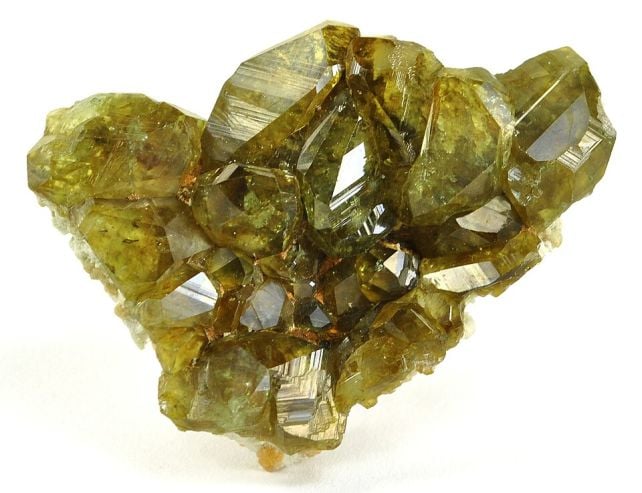

For this reason, the researchers nearly missed their discovery.
"This little section of the meteorite looked really interesting, and the chemistry was a bit odd," Kizovski says.
"At first, we assumed it was a mineral called pyroxene, which is very common, but then we decided to take a second look."
Those follow-up analyses confirmed that the mineral was andradite. Just a few grains were found in a tiny rock fragment measuring roughly 0.8 by 0.5 millimeters – smaller than a poppy seed.
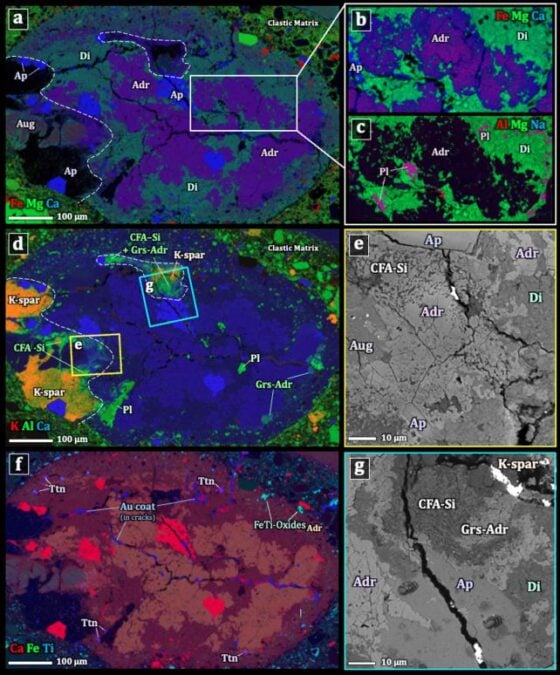
The meteorite, named NWA 8171, is already of intense interest to planetary scientists.
It consists of basaltic breccia – a type of rock that forms when magma cools and hardens around other blobs of mineral.
Its composition is a bit like a fruitcake, where the basalt is the doughy cake, and the other mineral inclusions are the fruits and nuts.
Between the basalt and its inclusions, NWA 8171 has a lot to say about Martian geology, from ancient magma flows to whatever information may be locked inside the grains.
This is what makes the discovery of garnet in NWA 8171 so exciting – because these minerals are particularly superb storytellers.
Garnets preserve excellent records of past geological processes, retaining unique snapshots of the temperature and pressure conditions under which they formed. They can also be used to date the timeline of these conditions, and often contain traces of other minerals that can reveal the chemistry of their formation environment.
The researchers don't yet know what that formation environment looked like, whether it involved an unusual type of magma not yet found on Mars, or whether the process was a metamorphic one.
"Garnet is a classic example of a mineral often found in metamorphic rocks on Earth. The process of metamorphism transforms igneous or sedimentary rocks into a new form through exposure to extreme heat, high pressure, or hot fluids," Kizovski explains.
"On Mars, the heat and pressure needed to produce garnet through metamorphism could have come from the impact of a meteorite hitting the surface of Mars, magma rising up into the Martian crust, or both."

The researchers also can not yet rule out the possibility that the garnet did not form on Mars.
Related: Curiosity Cracked Open a Rock on Mars And Found a Huge Surprise
Some of the chemistry of the garnet-bearing fragment looks Martian.
But because NWA 8171 is a breccia containing multiple kinds of material, it's still possible that the fragment could theoretically have originated elsewhere and landed on Mars before becoming incorporated into the breccia.
To investigate, the next step will be to look at isotope ratios in the mineral. If they are similar to isotope ratios in other Mars minerals, that will indicate that the garnet formed there – which, in turn, will shed new light on the red planet's deep geological history.
"The findings add a striking new dimension to our understanding of the geology of Mars," says planetary scientist James Darling of the University of Portsmouth in the UK, "and open an exciting new window into the evolution of our planetary neighbor."
The findings have been detailed in Geochemical Perspectives Letters.