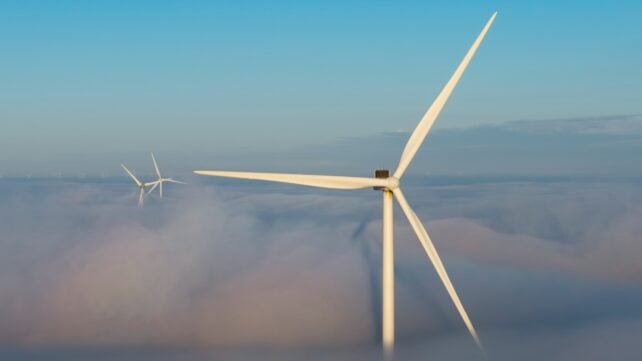
The world is increasingly reliant on energy from offshore wind farms, but there's a lot we're still learning about how they work out in the wild.
Most wind energy studies and models assume the skies are clear and dry. But in the real world, more often than not, our skies are cloudy – especially over the ocean.
A new study published in the Journal of Renewable and Sustainable Energy reveals how clouds can affect the way wind turbines generate power, and how wind turbines affect the clouds.
Scientists estimate that clouds typically cover about 67 percent of Earth's surface, based on satellite data. Above Earth's oceans, that coverage is even more extensive: research suggests less than 10 percent of the maritime sky is cloud-free at any given moment.
As more countries invest in offshore wind farms to transition away from reliance on fossil fuels for energy, the influence of clouds is something we really need to know more about.
"Accurately modeling wind farm-atmosphere interactions is essential for predicting power output and informing wind-farm design," writes a team led by physicist Davide Selvatici of the University of Twente in the Netherlands.
"The role of clouds in these interactions, however, remains poorly understood."
Clouds are surprisingly complex things, made of water droplets or ice.
They are usually suspended between two key boundaries in the atmosphere.
At the lower end, there's the atmospheric boundary layer (the air directly above the ground, which is influenced by friction from ground features like trees, hills, houses, and even the ocean's surface). At the top, there's the tropopause (the point where air stops getting cooler as altitude increases).
The atmospheric boundary layer rises and falls for many reasons, but the height of a wind turbine does not.
Yet, it's the atmospheric boundary layer that wind energy is harvested from.
This study focused exclusively on the influence of stratocumulus clouds, which sit low in the sky, often in a large, near-continuous bank, right at the top of the atmospheric boundary layer.
Selvatici and team simulated wind farms blanketed by stratocumulus clouds under different conditions.
They found that wind farms were able to harvest more wind energy when stratocumulus clouds were sitting under a layer of drier air.
That layer of dry air crowning the stratocumulus clouds has a cooling effect on the cloud itself, since dry air sends less heat back down to the cloud than moist air does.
The cooled air becomes heavy, but as it sinks, the movement stirs up the atmospheric boundary layer, which swells, actually pushing the whole sandwich of clouds upwards.
The turbines, in turn, are able to catch more of that energy.
Moist air on the cloud tops had the opposite effect. With less of a gradient of energy between the clouds and the air above them, there's less of an engine driving those powerful changes at the atmospheric boundary layer.
The layer sits low over Earth's surface, which stymies the traveling winds, slowing them down – and draining them of energy – by the time they reach the wind farm.
"An energy-budget analysis shows that the free-tropospheric conditions alter the boundary-layer depth and modify the downward turbulent transport of kinetic energy towards the wind farm," Selvatici and team conclude.
Interestingly, the turbines actually affect low, thin clouds, too.
"For shallow boundary-layer clouds with cloud base close to the rotor top, wind farms can reduce liquid water content and cloud cover, consistent with satellite observations," the team writes.
"Our results suggest that two-way wind farm-cloud interactions should be considered when planning and deploying large offshore wind farms."
It's pretty technical stuff, but these variables could have implications for wind farm projects, in terms of how the turbines are laid out, where they're built, and how much energy we can expect to get from them under different conditions.
Next, the researchers want to build similar simulations for a wider range of weather conditions and different wind farm design features.
The research has been published in Journal of Renewable and Sustainable Energy.
This article was fact-checked by Fiona MacDonald and edited by Fiona MacDonald. While we pride ourselves on our process, we are only human. If you spot a mistake, please let us know.