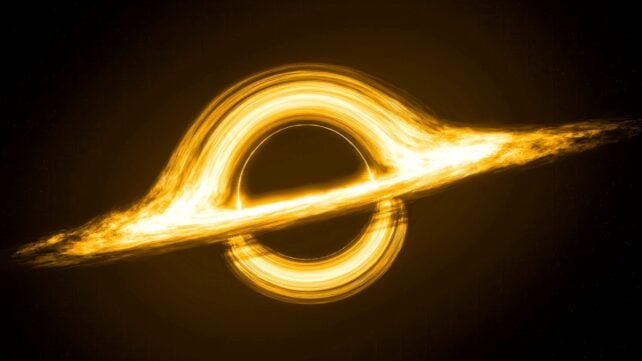
If you were to drift, suitless, through the vacuum of space, the brief moments before your death would be utterly silent.
That's because, in space, matter is simply not dense enough to carry a sound wave from one particle to another.
Sound is carried when particles in a medium jostle one another, transferring energy that, upon reaching our ears, causes the sensitive tympanic membrane to vibrate.
But that doesn't mean we can't experience space aurally.
There are a number of ways scientists have found to translate cosmic signals into soundscapes that are wild, uncanny, and even scientifically valuable.
Don't believe us? Check out our video below and prepare to be amazed by the ways you can 'hear' sounds in space – even a black hole:

Studying space is all about translating signals into meaningful information.
Most of the signals we receive from the cosmos are part of the electromagnetic spectrum – and human vision is limited to a relatively narrow range of that spectrum. Other signals can be measurements of waves in plasma, or gravitational ripples in the very fabric of spacetime.
The way information is encoded in radio waves or light transmitted by optical fiber for human communication is a good way to think about it. On their own, these signals carry no inherent meaning to our senses; they must first be decoded, or translated into a form we can interpret.
In astronomy, much of the data we receive is translated into a visual medium. This serves extremely well when we're dealing with light. But waves travel through space in various ways – and in some cases, it makes more sense to translate the data into sound.
For some efforts, such as NASA's data sonification project, that translation consists of a direct conversion of image data into sound – points of light turned into musical notes.
For others, it's a matter of taking wave data and mapping it into audible frequencies. That can be pressure waves propagating through hot gas around a supermassive black hole, or plasma waves along the lines of Earth's magnetic field.
Each body in the Solar System produces its own idiosyncratic soundscape.
The Sun, for instance, would be positively roaring as its surface roils with constantly rising and sinking convection cells larger than the state of Texas.
Scientists have estimated that, if sound could propagate through space, we could hear the Sun as a constant roar hammering at around an ear-bursting 100 decibels.

Saturn and Jupiter, with their complex systems of rings and moons, produce signals that, when translated, sound like the eerie music of alien cultures.
The very first sounds from space were recorded by astronomer Karl Guthe Jansky in 1933. He built a rotating radio telescope nicknamed Jansky's Merry-Go-Round, designed to detect a specific frequency range of radio waves.
When his data started coming in, there was a persistent background hiss that, Jansky discovered, was not random noise, but the radio emission from the heart of the Milky Way galaxy itself.
Related: Sound of The Big Bang Suggests Our Galaxy Floats Inside a Void
Translating this data into audio frequencies isn't just for fun (although it certainly is that too). It offers a different way of accessing and experiencing the data, which can, in turn, help scientists pick up on fine details that might otherwise be overlooked.
Space itself remains silent, as it has been since the Universe expanded enough to disperse the sloshing plasma that filled it during its infancy – leaving behind 'fossilized' sound waves in the distribution of galaxies.
However, with a little twist of technological trickery, we can open our ears to the cosmos and experience spacetime presented in a whole new way.