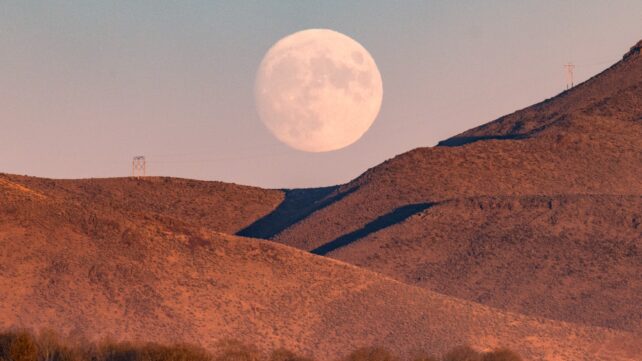
Cosmically, Earth can be likened to a planetary puppet 'tugged' by the gravitational strings of the Sun and Moon.
And the entire rest of the Universe, of course, but the lunisolar influence helps give us our ocean tides. It also causes tides in solid land and rock.
As the Sun and Moon exert these small but constant tidal stresses on Earth's crust, they have been observed to trigger creeping "slow earthquakes", which release their energy far more slowly than ordinary quakes and are imperceptible to us surface dwellers.
But exactly how they do so has remained relatively mysterious.
Until now, as new modeling suggests this could occur through resonance: similar to running one's wet finger around the rim of a wine glass to produce a harmonious (or annoying) ringing – only at planetary scales.
In a study published in the journal JGR Solid Earth, a team of geo-planetary scientists has modeled these tidal perturbations and found that a little goes a long way:
"Although these stresses are very small, typically of the order of a few kilopascals and comparable to the pressure from a gentle hand press, they have been observed to trigger slow earthquakes on some faults," the researchers say.
They analyzed the slipping, sliding, and grinding that occurs at tectonic plate interfaces using simulations with a spring-block model and rate-and-state friction.
In non-earthquake-ology lingo, this is a simplified model of a single patch of a fault. It also incorporates the ever-changing frictional resistance at the interface of a fault line, based on two factors: their velocity (rate) and how they contact each other (state).
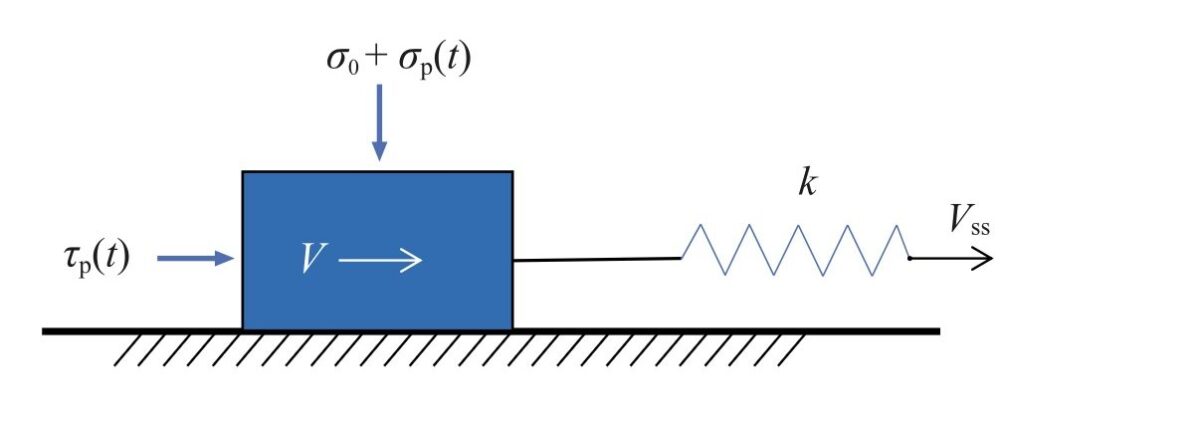
The fact that the equivalent of a pat on the back can trigger seismic events also depends on the type of fault that was modeled: one that's sliding at a stable rate but can be easily nudged out of its 'comfort zone.'
An increase in its velocity then causes the friction at the fault line interface to decrease, which can amplify the slip – in the model, enough to produce 'fast' slip events as well as slow ones.
Overall, the type of earthquake produced depends on the fault's relative frictional properties as it responds to two main factors, the researchers suggest: the amplitude (strength) and period (duration) of the tidal perturbation.
These factors may yield different results. If the amplitude of the tidal forces is low, a fault may continue to slide slowly and quietly.
But when the amplitude exceeds a threshold – and the period falls in the right range – it can cause a fault to slip and rumble.
The tidal perturbation duration can cause seismic activity if it matches a fault's "natural response timescale," or the time it takes to react to stressors at the fault interface and change its properties, such as friction (i.e., rate-and-state).
This resonance can trigger a slow event even if the perturbation is slight, "much like pushing a swing at the right rhythm makes it move higher," the researchers say.
The effects can be predictable, in line with real-world observations, like the tremors in southwest Japan and Cascadia (Pacific Northwest), which often peak at intervals of about 12 and 24 hours with the tides.
But perturbations can also induce temporally complex seismic activity that's more chaotic and unpredictable.
Finally, the researchers examined three possible timing patterns of tide-induced seismic events.
First, are seismic events triggered by the tidal stress maximum, when the tidal force is at its peak strength?
Secondly, are they triggered near the maximum tidal stressing rate, when the pressure from tidal force is rising the fastest?
Or, perhaps they occur randomly without a specific tidal pattern.
The model suggests that both scenarios apply, but it depends on the timing of the tidal cycle and the fault line's properties.

By modeling the influence of tidal perturbations on Earth's crust, this work provides a framework for interpreting tidal patterns in slow earthquakes, which could eventually feed into earthquake forecasting efforts.
For example, seismologists could 'reverse engineer' detected earthquakes to ascertain the properties of the faults, such as their frictional strength and how far they must slip before weakening, by matching measured seismic activity to tidal activity, which is easily known since it's somewhat difficult to lose track of the Sun and Moon.
Because this study models a single patch of fault zone in isolation, it may be better suited to simulating repeated, local low-frequency earthquakes (LFEs) rather than seismic events like tremors, which involve multiple patches and are more extensive.
Finally, because researchers have detected slow earthquakes across the exceptionally active subduction zones of the Pacific Rim, the team says they "provide valuable insights into stress accumulation and release along plate interface, and are therefore highly relevant for assessing the rupture potential and spatial extent of future megathrust earthquakes."
Megathrust earthquakes are the world's most powerful types of seismic upheaval, with the potential to generate devastating tsunamis and even bring volcanoes back to life.
The research has been published in JGR Solid Earth.
This article was fact-checked by Rebecca Dyer and edited by Rebecca Dyer. While we pride ourselves on our process, we are only human. If you spot a mistake, please let us know.