
It was January 1940, and the United Kingdom had a serious problem.
German attacks on import ships were threatening to trigger extreme food shortages, effectively starving the nation into submission.
Overnight, strict food rationing went into effect, limiting the amount of certain foods people could buy, including common staples like sugar.
Decades and entire lifetimes later, the long-tail effect of that enforced sugar reduction during World War II appears to have dramatically boosted the health of an entire generation of wartime babies, research suggests.
In a new paper published in PNAS, researchers analyzed health data from 64,761 people who were born in the UK between 1951–1956, sourcing their information from the UK Biobank study.
Sugar rationing ended abruptly in September 1953, after which average consumption levels quickly doubled.
By focusing on the 1951–1956 period straddling the cut-off, the researchers were able to compare the adult health of babies who spent their first 1,000 days (from conception to the age of two) under sugar rationing with babies who were born directly after and did not experience the limits.
They also compared the relative exposure of babies who experienced more of the sugar-rationing period to those born a little later, but still before restrictions lifted.
It's not the first time researchers have turned to this historical event and the unique scientific data it provides.
Previous studies have shown the sugar-rationed babies face lower chronic disease risks, along with lower chances of developing Alzheimer's, and they seem to enjoy better cardiovascular health.
But what about cancer risk?
The new study – by health economists Chen Zhu from China Agricultural University and Weilong Zhang from the University of Cambridge – answers that question, showing significant reductions in cancer incidence for babies whose sugar intake was limited in early life.
Though these babies and their parents didn't have to contend with modern-day advertising and stacked supermarket shelves enticing them with increasingly sweet foods, the findings are a window into how sugar (or lack thereof) impacts health.
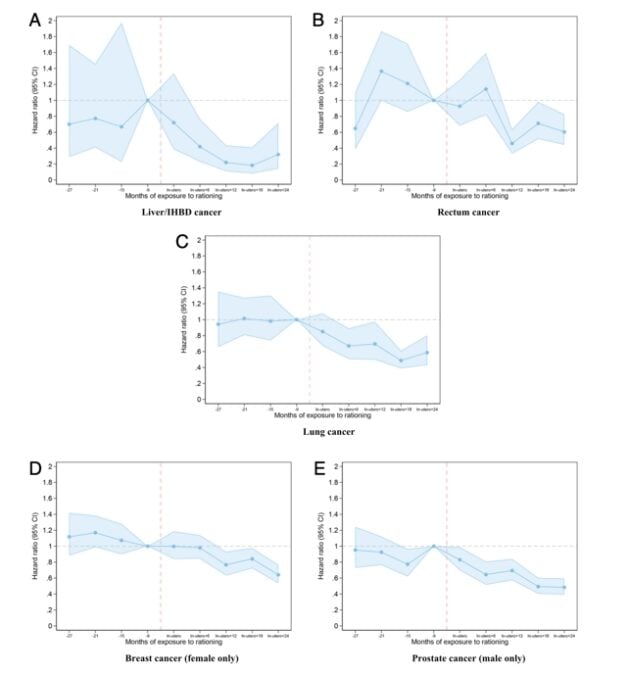
Compared with the babies who didn't experience sugar rationing, the babies who were sugar-rationed for their first 1,000 days were 69 percent less likely to develop liver cancer in their adult lives. They also saw reduced incidence of prostate cancer (52 percent lower), lung cancer (41 percent lower), rectal cancer (40 percent lower), and breast cancer (36 percent lower).
The sugar-rationed babies also tended to show longer telomeres – the caps at the ends of chromosomes that protect our genetic material, which are linked to longevity.
According to the researchers, the telomere length of the sugar-rationed babies equated to about 2.2 years less biological aging, suggesting they aged more slowly throughout their lives, enjoying better overall health than the non-sugar-rationed participants.
Another interesting finding was that the sugar-rationed babies appeared to show persistent dietary habits that lasted into adulthood, compared to their non-rationed peers.
"Rationed cohorts consume less sugar, eat smaller food quantities, and maintain healthier, more diverse diets five decades after the policy ended," the researchers write in their paper.

While we can't be entirely sure why that is, the researchers have some ideas.
"The level of sweetness people are exposed to very early in life may shape their taste preferences for a long time," Zhang explained in The Conversation.
"There appear to be two mechanisms at work. One is biological – early nutrition may shape how the metabolism, organs and immune system develop. The other is behavioral – a taste for less sweetness, formed early, seems to stick."
Related: Low Sugar in Baby's First 1,000 Days Reduces Chronic Disease Risk, Wartime Study Finds
While this was only an observational study, the researchers claim the experiment-like conditions of the sugar-rationing cut-off (which divided the participants into two discrete groups) produce a kind of "causal evidence" linking sugar intake to adult cancer risk.
That might be debatable, but the findings themselves are very clear.
In a time of war, a generation of children was forced to restrict themselves to the levels of sugar intake comparable to what the World Health Organization recommends for everybody today.
And what do you know? They were healthier.
The findings are reported in PNAS.
This article was fact-checked by Clare Watson and edited by Clare Watson. While we pride ourselves on our process, we are only human. If you spot a mistake, please let us know.