Complex lifeforms can be pretty picky when it comes to temperature.
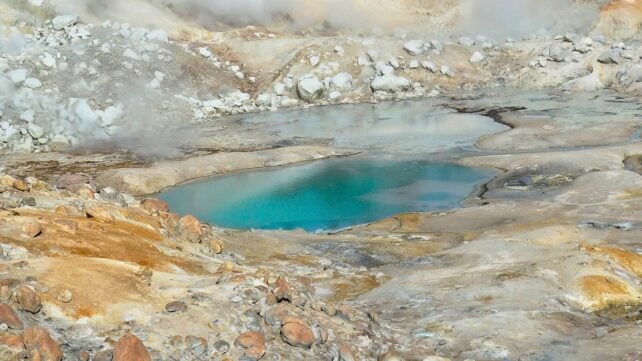
Now, one newly discovered amoeba, which calls a sweltering 63 °C (145 °F) geothermal spring in California's Lassen Volcanic National Park home, has just broken the upper temperature limit for eukaryotic life.
Scientists have dubbed it Incendiamoeba cascadensis: fire amoeba of the Cascades.
It was one of several organisms collected from the national park's geothermal streams.
But unlike some of its neighbors, this amoeba continued to maintain its vigor even at the previous record for amoeba growth (57 °C, or 135 °F) in the laboratory.
So Syracuse University biologist Angela Oliverio and her colleagues kept turning up the heat.
The ability to create and maintain all the proteins that make up a living thing tends to be strictly governed by temperature. Too cold, and the machinery of life slows to a halt. Too hot, and its raw materials fall apart.
That window of thermal tolerance differs from creature to creature, but some are better at surviving extremes.
Until now, scientists thought the most heat any eukaryotes could tolerate was 60 °C (140 °F). Eukaryotes are complex organisms with distinct organelles inside their cells. It's a biological grouping that includes the animal, plant, fungi, and protist kingdoms.
Their simpler, more ancient counterparts, prokaryotes, are members of the kingdoms bacteria and archaea. The archaeon Methanopyrus kandleri, a simple microorganism that lives around hydrothermal vents deep in the ocean, holds the title for the hottest organism on record, withstanding 122 °C (252 °F).
But among eukaryotes, I.cascadensis "pushes the bounds of what we thought was possible, which is incredibly exciting," Oliverio says.
"There could be more eukaryotes that can survive at even higher temperatures than we know of."
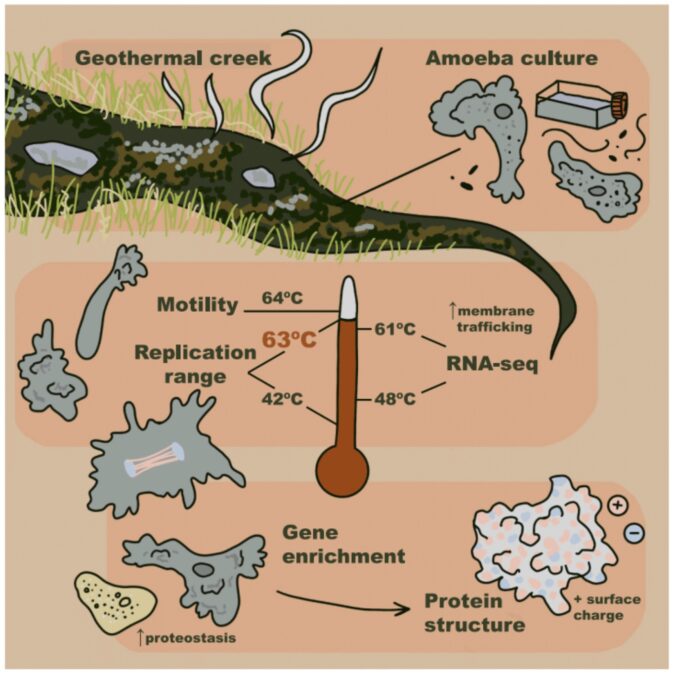
At 63 °C, the amoeba was still capable of undergoing mitosis, in which cells replicate themselves asexually.
Beyond that temperature, the amoeba wasn't able to keep growing, but the scientists saw it had some extra survival strategies up its amorphous sleeves.
The cellular machinery the amoeba uses to protect its proteins, repair DNA, and move materials across membranes went into a frenzy as the temperatures rose.
Some heat-loving bacteria and archaea reinforce their proteins with the extra protection of positively charged amino acids. That same strategy was seen in I.cascadensis, which may similarly help it cope with temperature stress.
"Even though these organisms are so different, there's convergence in how protein properties are selected for stability under high temperatures," says first author Beryl Rappaport, a biologist in Oliverio's lab at Syracuse University.

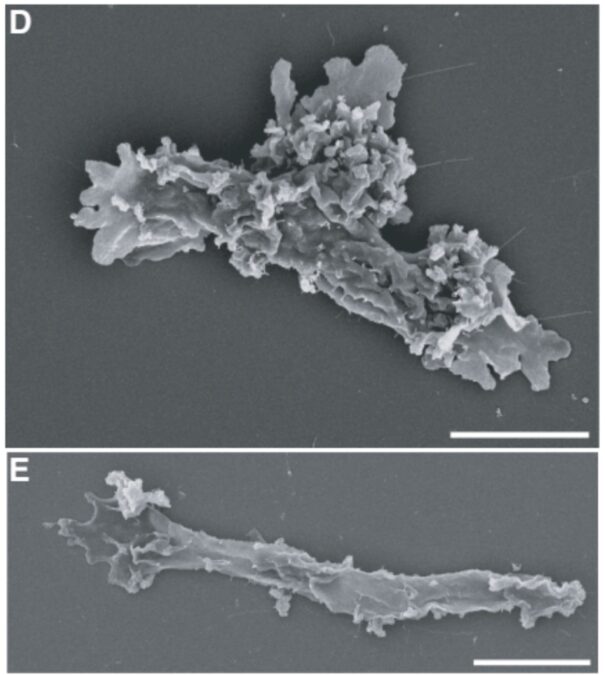
Above 64 °C, the amoeba took on a cyst-like form, bundling its single-celled body into a round shape. Amoebas are known to use this strategy to enter a state of dormancy when the going gets tough.
Its cyst-like body also displayed rapidly moving, hairy-looking structures, which the scientists think may be involved in sensing temperature.
Even after the amoeba had been exposed to 70 °C heat, once it returned to 60 °C, it could resume normal growth. But it seems even I.cascadensis has its limits: after being blasted with 80 °C heat, it wasn't able to recover.
In a world where things are only going to get hotter in coming decades, it's nice to know that some of the life forms on Earth are already well-equipped to cope.
The research was published in Cell.
This article was fact-checked by Rebecca Dyer and edited by Rebecca Dyer. While we pride ourselves on our process, we are only human. If you spot a mistake, please let us know.