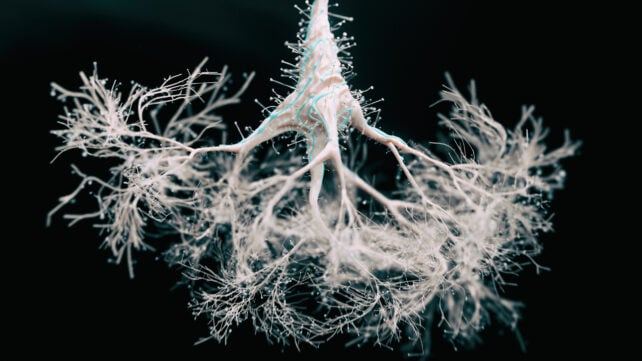
In the brains of people with Alzheimer's and certain other types of dementia, two proteins called amyloid-beta and tau start misbehaving in different ways – though it's not clear if these abnormalities are drivers of the disease, or consequences of it.
With tau, the protein begins to misfold into the wrong shape, and collects together in threads called fibrils inside brain cells, eventually killing those cells off. A long-standing question has been how this misfolding spreads through the brain.
Now, thanks to a study published in PNAS from researchers at Northwestern University and the University of California, Santa Barbara, we may have an answer.
The study team determined that tau proteins with certain mutations are more vulnerable to misfolding, and that there's a certain 'hotspot' on these proteins that can connect them together. The hotspot repels water but is still capped by it, and when that water is released, the proteins join together in the rigid fibril shape.
"You have a certain site, and water cannot quite coat it because it doesn't like water," says physical chemist Songi Han, from Northwestern University. "But that part still needs to be protected, because if you don't, then the protein crashes out and is no longer available."
"What water tends to do is build a stabilizing cap around it and basically these water caps attract each other."
The researchers studied a fragment model of mutated tau made up of 19 amino acids, combining lab tests with computer modeling to figure out how the proteins could go from soft and shapeless initially to rigid and stacked as fibrils.
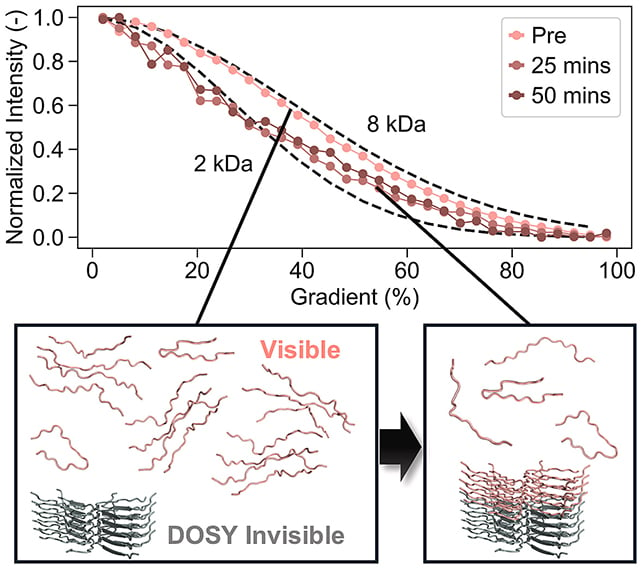
Via a docking method that happens in stages – with the first stage at the water-capped hotspot – there's a release of energy that is then used to recruit a new tau and trigger the misfolding process.
"The proteins have to misfold and neatly stack to fibrils to elongate while propagating the same misfolded shape, and the only way that this process is forever is if the same site of the protein stacks to the same," says Han.
"If you have a tiny mismatch in the alignment of the tau shapes that stack to the fibril end, the structure will eventually stop growing."
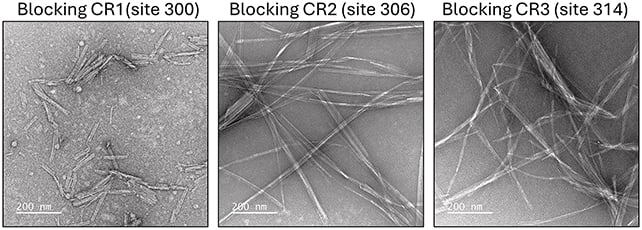
Further tests showed that when the hotspot was covered by a chemical tag, the fibrils stopped growing. While it's still very early days for the research, there's potential here for drugs that can take aim at this docking point and stop connections being made.
Left unchecked, when cells holding tau fibrils die off, those fibrils are released to then start the process in other neurons, so the problem spreads through the brain.
"Once you know that aggregation-prone tau proteins always have a hotspot that is first attracted to the same site of tau that is stacked to fibrils, then you know there's always some part of the protein that you can target to neutralize," says Han.
"If you know where to block its action of misfolding, you could block it to prevent it from propagating."
One of the ideas suggested by the researchers is creating synthetic tau fibrils that could be used to study the progression of Alzheimer's and dementia more generally. A better understanding of how fibrils form will be crucial to making artificial versions.
Studying abnormal tau and amyloid-beta proteins at the moment is a real challenge for researchers — getting inside the brain of a living patient is incredibly difficult to do, and in post-mortem brains donated to science all the dementia processes have stopped.
"In order to cure a disease, one needs to be able to recreate it," says Han. "There's a real problem that disease-mimicking tau fibrils cannot be synthetically made easily. It's really difficult to try to do any development with human patient tissue."
"We are trying to give the principle of how it works so that others can find solutions better, faster or more rationally."
The research has been published in PNAS.
This article was fact-checked by Fiona MacDonald and edited by Fiona MacDonald. While we pride ourselves on our process, we are only human. If you spot a mistake, please let us know.