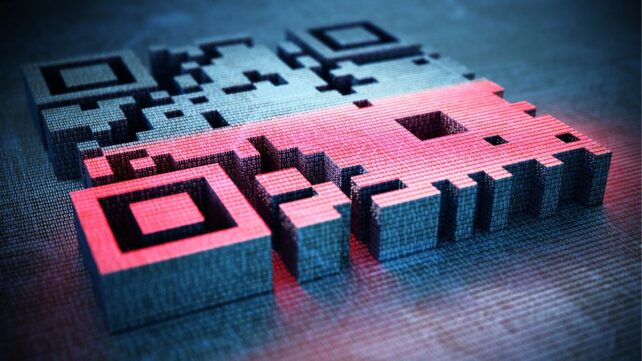
The smallest QR code in the world is so very tiny that your phone would need an electron microscope to scan it.
The matrix barcode covers just 1.977 square micrometers. That's smaller than some bacterial cells or air pollutants.
The seven scientists who created it were awarded the Guinness World Record on 3 December 2025.
Their creation is about one-third the size of the previous world record holder.
The team was led by researchers at Austria's Vienna University of Technology (TU Wien) in conjunction with the data storage technology company Cerabyte.
"The structure we have created here is so fine that it cannot be seen with optical microscopes at all," says materials scientist Paul Mayrhofer from TU Wien.
"But that is not even the truly remarkable part. Structures on the micrometer scale are nothing unusual today – it is even possible to fabricate patterns made of individual atoms. However, that alone does not result in a stable, readable code."
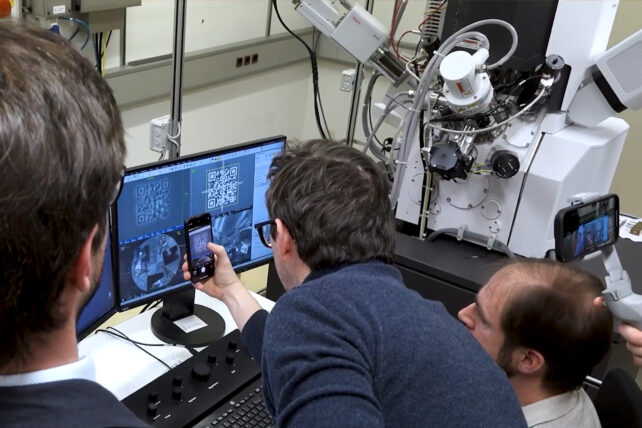
Despite its tiny size, when Mayrhofer and colleagues tested their QR (Quick Response) code, it worked.
The readout process for the Guinness World Record was done in the presence of witnesses and confirmed by the University of Vienna as an independent verifier.
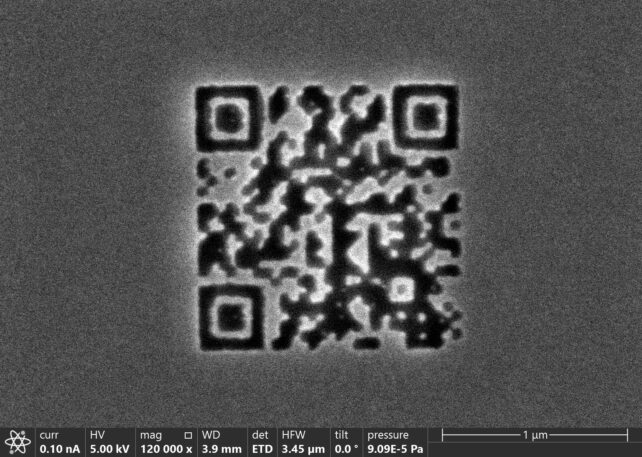
The key to making a QR code this small was to print it on a thin ceramic film, designed for coating high-performance cutting tools. Focusing ion beams on this material, the team cut their QR code with pixels only 49 nanometers in size.
That's a measurement ten times smaller than the wavelength of visible light, which means the code is completely invisible to the human eye.
Related: World's Tiniest Pixel Shatters Records… But There's a Catch
"With ceramic storage media, we are pursuing a similar approach to that of ancient cultures, whose inscriptions we can still read today," says Tu Wien materials scientist Alexander Kirnbauer.
"We write information into stable, inert materials that can withstand the passage of time and remain fully accessible to future generations."

The team behind the QR code now hopes to make other tiny forms of ceramic data storage that are highly durable and could leave a smaller carbon footprint than current storage options.
In just one A4 piece of paper, Kirnbauer, Mayrhofer, and colleagues estimate their method could store more than 2 terabytes of data.
A potentially tiny solution to a big problem.